Published on February 4, 2025
Wouldn't it be lovely if the economy just kept growing forever, like a really enthusiastic golden retriever that never gets tired? We could all get richer indefinitely, housing prices would climb to the moon (where they apparently belong), and unemployment would become a quaint historical concept like using rotary phones or trusting politicians.
Unfortunately, economies are more like teenagers than golden retrievers. They're moody, unpredictable, and occasionally decide to sulk in their rooms for months at a time.
When the Economy Decides to Take a Snow Day
A recession is basically the economy's way of saying, "You know what? I've been working really hard lately, and I think I'll just... not... for a while." Technically, it's defined as two consecutive quarters of declining GDP, but that's just economists trying to sound scientific about something that's essentially the economic equivalent of seasonal depression.
What typically triggers the economy's periodic emotional breakdowns? Well, after years of watching Canadian economic cycles, I've noticed a few patterns:
Consumer Confidence Collapse: People suddenly remember that debt exists and decide maybe they don't need that third streaming service or daily Starbucks habit. When millions of people simultaneously realize they should probably save money instead of spending it, the economy gets confused and sad.
Corporate Anxiety Attacks: Businesses start worrying about the future and begin cutting costs, which usually means firing people, which means fewer people have money to spend, which makes businesses worry more. It's like economic hypochondria, everyone convinces themselves they're sick until they actually become sick.
Banking Gets Conservative: Banks suddenly remember that lending money to people who can't pay it back is a bad idea. They tighten credit standards, making it harder for businesses and individuals to borrow money, which slows everything down. It's like the financial system suddenly deciding to eat salad after years of pizza and beer.
The Great Recession Reality Check
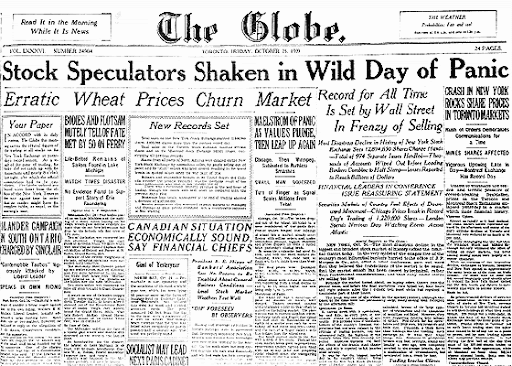
The most dramatic example of economic moodiness was the Great Depression of the 1930s, when unemployment hit 25% and people discovered that stock certificates make terrible toilet paper. This particular economic breakdown lasted about a decade and required a world war to finally snap the economy out of its funk.
The Depression taught us that recessions can spiral into something much worse if nobody knows how to handle them. It's like the difference between having a bad day and having an existential crisis that lasts for years.
Modern economists studied this disaster and concluded that maybe governments should actually do something when the economy starts having a breakdown, rather than just hoping it sorts itself out like a temperamental teenager.
The Necessary Evil Theory
This is where economics gets philosophically interesting: many experts argue that recessions are actually necessary, like hangovers after a really good party. You can't appreciate good times unless you've been through bad ones, and this folk wisdom turns out to align with economic theory. The theory is that economic booms create imbalances, too much speculation, too much debt, too many people convinced that housing prices can only go up.
A recession acts like an economic detox program, forcing out the excesses and bad decisions that accumulated during the good times. Companies that were barely profitable get weeded out. Speculative bubbles pop. People remember that borrowing money eventually requires paying it back.
Think of it like cleaning out your garage: unpleasant but ultimately beneficial. The difference is that economic cleanouts involve unemployment, business failures, and a lot more complaining than organizing old Christmas decorations.
The Canadian Approach to Economic Turbulence
Canada has developed its own approach to handling recessions, which basically involves being more boring than everyone else. Our banking system is heavily regulated, which means our banks are less likely to do exciting but stupid things with money.
During the 2008 financial crisis, while American and European banks were collapsing like houses of cards in a windstorm, Canadian banks just... continued being banks. It was like watching a disaster movie where the Canadian characters are the ones who actually read the safety manual beforehand.
This boring approach has served us well. We still get recessions, but they tend to be shorter and less dramatic than what happens elsewhere. It's the economic equivalent of wearing a winter coat in November instead of waiting until January and then being surprised that it's cold.
The Government's Economic Toolbox
Modern governments have developed various tools for fighting recessions, like a really expensive Swiss Army knife designed by economists:
Monetary Policy: Central banks can cut interest rates to make borrowing cheaper, which encourages spending and investment. It's like economic espresso, designed to wake things up and get them moving again.
Fiscal Stimulus: Governments can spend money on infrastructure, unemployment benefits, and other programs to keep money flowing through the economy. This is the economic equivalent of giving CPR to someone who's passed out at a party.
Quantitative Easing: When regular interest rate cuts aren't enough, central banks can create new money and use it to buy bonds, injecting cash directly into the financial system. This sounds like counterfeiting but is apparently legal when central banks do it.
The Skip-the-Recession Fantasy
So can we just eliminate recessions entirely? It's tempting to think that with enough economic engineering, we could create a perpetual growth machine that never breaks down.
It's like asking if we can eliminate winter. Technically possible if you move to the equator, but you'd miss out on all the things that make the other seasons special.
The problem is that preventing all recessions might be like taking pain medication before exercising. You avoid the immediate discomfort but may cause worse problems later. Economic booms and busts seem to be natural cycles that help markets self-correct and adapt to changing conditions.
Plus, completely preventing recessions would require governments and central banks to perfectly predict and control human behavior, which is about as likely as successfully herding cats while riding a unicycle.
The Silver Lining Department
Recessions do serve some useful purposes beyond just humbling overconfident economists:
They encourage innovation as companies look for more efficient ways to operate. They remind people about the value of saving money and living within their means. They clean out inefficient businesses and practices that were only surviving during good times.
Most importantly, they make the subsequent recovery feel that much better. It's hard to appreciate economic good times if you've never experienced the alternatives.
The Bottom Line (During a Downturn)
Recessions are like Canadian winters, inevitable, occasionally brutal, but something we've learned to manage through preparation and appropriate equipment. You can't prevent them entirely, but you can reduce their impact through good policy, sensible regulations, and maintaining the kind of boring financial system that works reliably instead of excitingly.
The goal isn't to eliminate economic cycles but to manage them better. Think of it as economic snow removal: you can't stop winter from happening, but you can make sure the roads stay passable.
Next time someone asks why we can't just skip recessions, remind them that economic systems, like people, occasionally need time to rest, recover, and figure out what they're doing wrong.
At least recessions don't last as long as Canadian winters. Usually.
References:
Books:
- Kindleberger, Charles P. Manias, Panics, and Crashes. Palgrave Macmillan, 2023.
- Krugman, Paul. The Return of Depression Economics. W. W. Norton & Company, 2009.
- Galbraith, John Kenneth. The Great Crash 1929. Mariner Books, 2009.
Government and Institutional Sources:
- Bank of Canada, "Recession Analysis and Economic Cycles," 2024
- Statistics Canada, "Business Cycle Analysis," 2024
- C.D. Howe Institute, "Understanding Economic Downturns," 2024
- Personal experience wondering why the economy can't just behave itself