Published on February 10, 2025
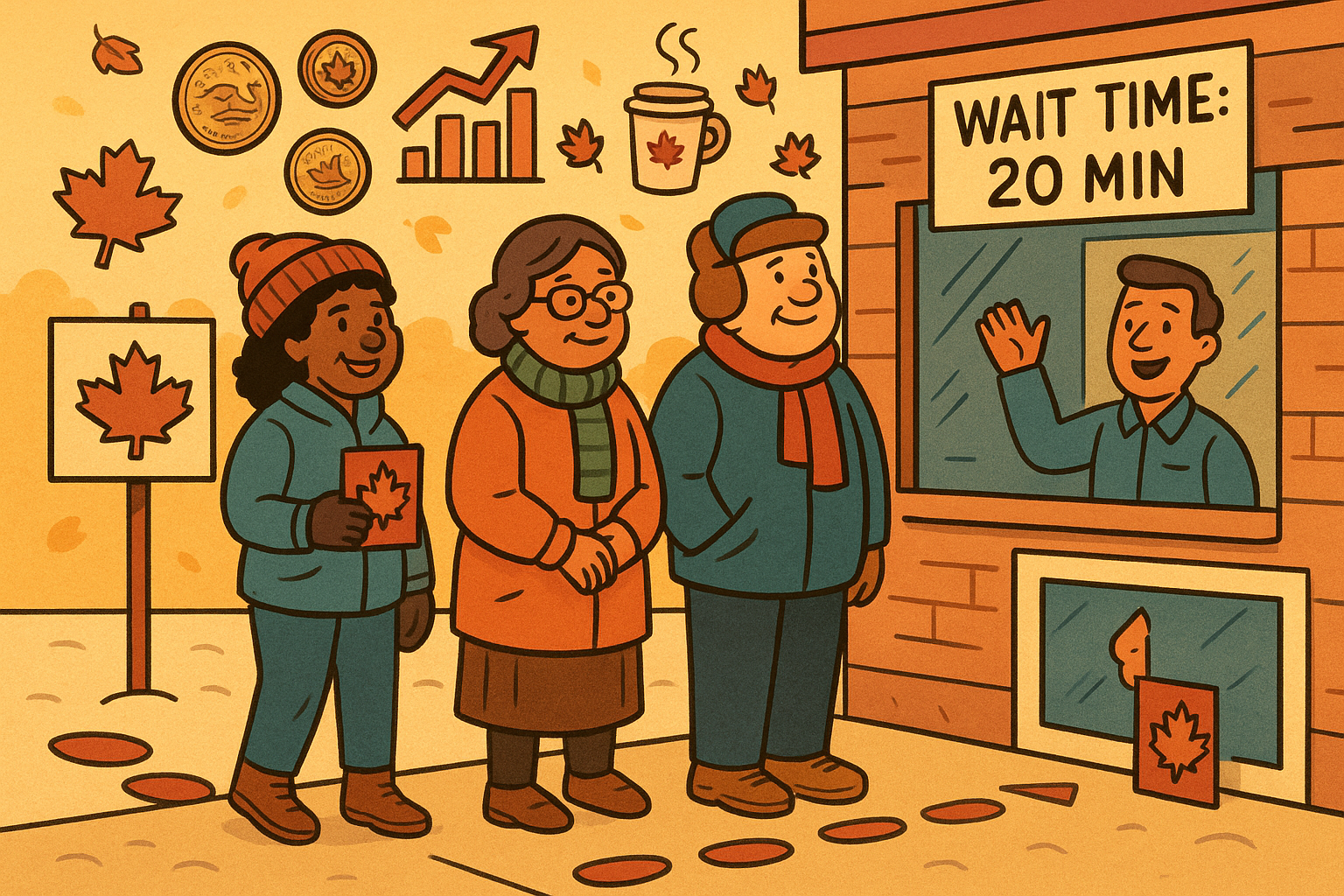
You know you're in Canada when people form an orderly line to wait for the next available line. Twenty people queue up single-file at a Tim Hortons, and when they run out of double-doubles, everyone just... stays in line. Someone even says "sorry" to the cashier for their inconvenience.
This wasn't just a weird Canadian stereotype come to life. This was economic infrastructure in action.
The $20 Million Dollar Line
Here's something that'll blow your mind: the average Canadian spends about 37 minutes per day waiting in various lines and queues. That's over 200 hours per year, or roughly five full work weeks of our lives spent standing behind other people.
Multiply that by our population and wage rates, and we're talking about billions of dollars worth of productivity happening in lineups. Yet somehow, our economy doesn't collapse from all this waiting. If anything, it works better because of it.
Why? Because Canadian queue discipline is like a massive, invisible operating system that keeps society running smoothly.
The Great Tim Hortons Experiment
Ever accidentally cut in line at a Tim Hortons? The reaction is swift and devastating.
No one yells. No one shoves. Instead, you experience something far worse: polite disappointment. An elderly woman gently taps your shoulder and says, "Excuse me, dear, but I think the line starts back there." The collective sighs of quiet disapproval are more crushing than any angry confrontation.
I slunk to the back of the line, properly chastened, and realized I'd just violated one of Canada's most sacred economic principles: fairness through orderly process.
Why Lines Work (When They Work)
Think about it: every time you get in line, you're entering a social contract. You're essentially saying, "I'll wait my turn if everyone else does too." It's like a massive trust exercise involving strangers, caffeine, and the promise of eventual service.
This system works because Canadians have mastered what economists call "queue discipline." We've collectively agreed that:
First come, first served is sacred: Whether you're buying concert tickets or waiting for healthcare, your place in line matters more than your wealth, connections, or ability to yell loudly.
Everyone plays by the same rules: A billionaire waits behind a student at the bank machine. A CEO stands in line for coffee like everyone else. Democracy in action, one queue at a time.
Patience pays off: The system only works if people believe their wait will eventually be rewarded. Break that trust, and the whole thing falls apart.
When Waiting Goes Wonderfully Wrong
Of course, not all Canadian lineups are created equal. Sometimes our politeness creates its own problems.
Ever stand in a line where nobody was quite sure what they were waiting for? The first person stopped to tie their shoe, the second person thought they were queuing for something, and the rest just assumed there must be a good reason. Fifteen minutes later, someone finally asks, "Um, what are we waiting for?"
Turns out we were all just being polite to a person with untied footwear.
But here's the beautiful part: even when our queueing instincts lead us astray, they demonstrate something valuable. We'd rather err on the side of unnecessary politeness than risk being rude. That's a cultural trait you can't fake, and it has real economic value.
The Healthcare Queue Reality Check
Now let's talk about the elephant in the waiting room: healthcare lineups. This is where Canadian patience gets tested, and where our queueing culture shows both its strengths and limitations.
Emergency rooms use triage systems, which is basically line-jumping based on medical need. The person with chest pains rightfully goes ahead of someone with a sprained ankle, even if they arrived later. Most Canadians accept this because we understand that some things are more important than strict queue order.
But when wait times get excessive, it signals system breakdown, not queue jumping. If you're waiting six months for knee surgery, that's not a line problem. That's a capacity problem. The queue is working; there just aren't enough surgeons.
The Airport Security Paradox
Canadian airports present a fascinating study in queue psychology. We'll wait patiently for an hour to get through security, then politely remove our shoes, unpack our laptops, and submit to various indignities, all while saying "please" and "thank you" to people who are essentially searching us for weapons.
Only Canadians would turn potential confrontation into a customer service interaction. We've somehow convinced ourselves that airport security lineups are just really slow, really thorough customer service.
Lines as Economic Infrastructure
What economists love about Canadian queue culture is how incredibly efficient it is at resource allocation. When everyone waits their turn, you don't need expensive enforcement mechanisms, complex priority systems, or security guards to maintain order.
Compare this to places where queue-jumping is common. You need more staff, more surveillance, more conflict resolution. All of which costs money and creates inefficiency. Our politeness literally saves the economy millions of dollars in enforcement costs.
Plus, orderly queues create predictable service times, which helps businesses plan staffing and customers plan their time. When everyone knows the system works fairly, participation increases and satisfaction goes up.
The Digital Queue Revolution
The pandemic taught us something interesting: Canadians are just as polite in virtual lineups as physical ones. We'll sit in Zoom waiting rooms without complaint, patiently hold for customer service, and even wait in online queues to buy concert tickets.
We've successfully transferred our queueing culture to the digital realm, which is actually kind of impressive. Not every society could make that transition so smoothly.
The Ultimate Canadian Truth
Canadian queueing culture reveals something profound about our national character: we've built a society that works because people generally want it to work. We wait in line not because we're forced to, but because we believe in fairness, order, and collective good.
This isn't just politeness. It's sophisticated social technology. We've created systems that depend on voluntary cooperation, and somehow, they actually function.
So the next time you're standing in line for your double-double, remember: you're not just waiting for coffee. You're participating in one of Canada's most successful economic experiments. A system built on trust, maintained by politeness, and powered by the radical idea that fairness matters more than convenience.
Not bad for a country that apologizes to automatic doors.
References:
Books:
- Andrews, David The Psychology of Waiting Lines. Workman Publishing Company, 2015.
- Hochschild, Arlie Russell. The Managed Heart. University of California Press, 2012.
Government and Institutional Sources:
- Statistics Canada, "Time Use Survey 2024"
- Transport Canada, "Airport Wait Time Analysis," 2024
- Personal observation at literally every Tim Hortons in existence