Published on May 10, 2026
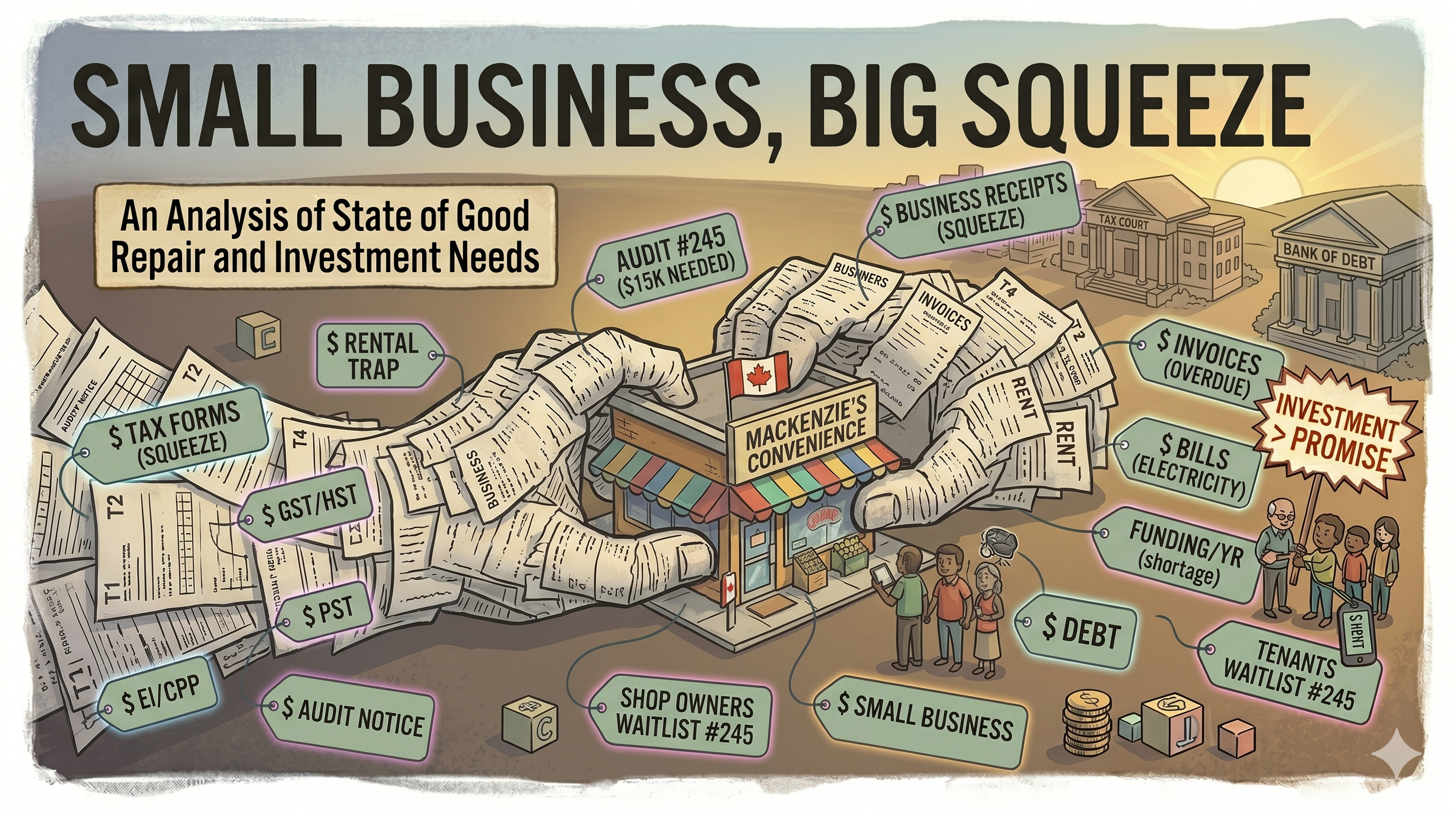
You walk past them every day. The bakery on the corner, the auto repair shop down the block, the accountant above the pizza place. They look ordinary, unremarkable even. But behind every one of those storefronts is someone staring at a spreadsheet at midnight, trying to figure out how to make the numbers work for another month.
Small businesses in Canada aren't a niche topic — they are the economy. According to Statistics Canada's business registry, businesses with fewer than 100 employees make up roughly 98% of all employer businesses in this country [1]. They account for about 70% of private-sector employment. When you buy a coffee, get your car fixed, or hire someone to do your taxes, you're almost certainly dealing with a small business. And right now, a lot of those businesses are getting squeezed from every direction at once.
The Rent Is Too Damn High (Commercial Edition)
If you think residential rent in Toronto or Vancouver is painful, take a look at what commercial tenants are paying. Average asking rents for retail space in downtown Toronto have been hovering around $35 to $50 per square foot net, depending on the neighbourhood. In Vancouver, similar story. Even in Calgary and Ottawa, commercial rents have been climbing steadily as vacancy rates tightened post-pandemic [2].
For a small retailer renting 1,000 square feet — and that's a modest space, barely enough for a decent bookshop — you're looking at $35,000 to $50,000 a year in base rent alone in a major city. Then add in triple-net costs: property taxes, insurance, and common area maintenance, which can tack on another $15 to $25 per square foot. Suddenly your cozy little shop costs $50,000 to $75,000 a year just to exist, before you've sold a single thing.
And unlike residential tenants, commercial tenants in most provinces have almost no rent control protections. Your landlord can bump the rent at renewal by whatever the market will bear. If your neighbourhood gets trendy — congratulations, you helped make it that way, and now you can't afford it.
The Payroll Tax Pile-On
Every time a small business owner hires someone, they trigger a cascade of mandatory contributions that most employees never think about. Consider what an employer actually pays on top of wages:
- Canada Pension Plan (CPP/CPP2): Employers match employee contributions. With CPP2 expansion now fully phased in, the combined employer-employee contribution rate on pensionable earnings has climbed significantly. For an employee earning $68,500, the employer's share of CPP contributions alone runs over $4,000 annually [3].
- Employment Insurance (EI): Employers pay 1.4 times the employee premium rate. On an employee earning the maximum insurable earnings, that's roughly $1,500 in employer EI premiums per year.
- Workers' Compensation: Rates vary wildly by province and industry, but a small construction firm in Ontario might pay $3 to $6 per $100 of payroll. A restaurant? Around $1.50 to $2.50. It adds up fast.
- Provincial health premiums: In some provinces, employers contribute to health levies based on total payroll.
Add it all up and an employee who earns $50,000 in wages might actually cost the business $57,000 to $62,000 depending on the province and industry. That 15-to-24% premium over the wage itself is invisible to most workers, but it's very visible on the business's books.
Minimum Wage: A Moving Target
Minimum wages across the provinces have been on a steady climb, and the patchwork of rates makes planning a nightmare for businesses operating in multiple provinces:
- British Columbia: $17.85/hour
- Ontario: $17.20/hour
- Alberta: $15.00/hour (unchanged since 2018, a notable outlier)
- Quebec: $16.10/hour
Several provinces have tied future increases to inflation indexing, which means the number moves every year whether margins can absorb it or not [4].
Nobody serious argues that workers shouldn't earn a livable wage. That's not the debate. The question is what happens to a café owner whose labour costs jumped 25% over four years while their menu prices only went up 15% because customers have limits. The answer is thinner margins, fewer hours offered to staff, or — increasingly — automation. Ever noticed how many restaurants have switched to tablet ordering? That's not because they love technology. It's because a tablet doesn't trigger CPP contributions.
The 9% Tax Rate That Isn't Really 9%
Canada's federal small business tax rate is 9% on the first $500,000 of active business income. Combined with provincial rates, most small businesses pay between 11% and 13% total on eligible income. On paper, that's generous — far lower than the general corporate rate of 15% federal plus provincial.
In practice, the effective cost of tax compliance eats into that advantage substantially. The Canadian Federation of Independent Business (CFIB) has estimated that regulatory compliance costs Canadian businesses over $40 billion annually, with small businesses bearing a disproportionate share per employee [5]. A business with five employees spends roughly $7,000 to $10,000 per employee per year on regulatory compliance — nearly five times what a large corporation spends per employee.
That includes bookkeeping for GST/HST remittances, payroll source deductions, T4 filings, corporate tax returns, municipal licensing, health and safety documentation, and the ever-growing stack of forms that arrive in the mail or, increasingly, in your CRA My Business Account inbox. Many small business owners spend the equivalent of one full working day per week on paperwork and compliance rather than actually running their business.
Borrowing Money When the Bank Says "Maybe"
For years, small businesses could access credit at historically low interest rates. The Bank of Canada's overnight rate sat near zero through much of 2020 and 2021, and even as rates rose through 2022-2024, small business lending remained active. But the rate hike cycle that peaked in 2023 — with the overnight rate hitting 5.0% — left a lasting mark on small business credit [6].
Even as rates have started to ease, banks have tightened their lending criteria. The Business Development Bank of Canada (BDC) reported that small business owners increasingly cite access to financing as a top concern, particularly for newer businesses without established credit histories. A small business line of credit that might have carried a 4% rate in 2021 now sits at 7% to 9%. On a $200,000 operating line, that's an extra $6,000 to $10,000 in annual interest costs — money that comes straight out of cash flow.
And then there's the CEBA question. The Canada Emergency Business Account provided $60 billion in interest-free loans of up to $60,000 to small businesses during the pandemic. The partial forgivable portion (up to $20,000) was contingent on repayment by the deadline, which was extended to December 2023. Businesses that couldn't repay in time saw their loans convert to three-year term loans at 5% interest [7]. For many, that conversion added yet another fixed obligation to an already tight budget.
The Amazon in the Room
Walk down any main street in Canada and count the empty storefronts. Then go home and check your Amazon order history. Those two things are not unrelated.
Small retailers are competing against companies that operate continental-scale logistics networks, negotiate bulk purchasing deals that no independent shop can match, and treat razor-thin margins as a business strategy rather than a crisis. When Amazon can deliver a product to your door in two days at a price that's lower than what a small retailer pays wholesale, the playing field isn't just tilted — it's practically vertical.
According to Statistics Canada, e-commerce retail sales have grown to represent a substantial share of total retail trade, and the trajectory keeps climbing [8]. Small businesses that haven't built an online presence are losing customers to competitors they'll never even see. And building that online presence costs money, time, and expertise that most small operators don't have sitting around.
The irony is that consumers say they want to support local businesses. Surveys consistently show that Canadians express a preference for shopping local. But when a book costs $22 at the independent bookshop and $15 on Amazon with free shipping, most people's wallets make the decision for them. Loyalty is a lovely sentiment, but it has a price ceiling.
The Red Tape Tangle
Start a small business in Canada and you'll quickly discover that multiple levels of government all want to know about it — and each has its own forms, fees, and timelines.
Municipal business licences. Provincial incorporation or registration. Federal tax accounts. Industry-specific permits. Health inspections if you serve food. Liquor licences if you serve drinks — a process that in Ontario can take months and cost thousands. Accessibility compliance. Signage bylaws. Zoning requirements that sometimes make it illegal to run a business from the very type of building where businesses have operated for decades.
The CFIB has been tracking regulatory burden for years and consistently finds it's one of the top concerns for small business owners, often ranking above taxes [5]. It's not that individual regulations are unreasonable — most exist for good reasons. It's the cumulative weight. Each form takes 20 minutes, each permit takes a week, each inspection takes a half-day of preparation. Multiply by a dozen requirements and you've lost a month of productive time before the doors even open.
Some provinces have made progress. British Columbia's regulatory reform efforts and Ontario's "Ontario One" business registration portal have simplified certain processes. But the fundamental problem remains: small businesses face the same regulatory complexity as large ones, without the compliance departments to manage it.
What's Actually Working
It's not all doom and spreadsheet anxiety. Several developments are genuinely helping small businesses, even if they don't always make headlines.
Digital adoption programs: The Canada Digital Adoption Program (CDAP) has helped thousands of small businesses develop digital strategies and adopt e-commerce tools. Grants of up to $2,400 for micro-grants and $15,000 for larger digital adoption plans have allowed businesses to build online stores, upgrade point-of-sale systems, and reach customers they never could have found from behind a counter [9].
Export support: Programs through Export Development Canada (EDC) and the Trade Commissioner Service are helping small businesses access international markets. For a specialty food producer in Quebec or a tech startup in Waterloo, selling to 40 million Canadians is nice — selling to 8 billion humans is better.
The BDC's role: As a Crown corporation dedicated to small business lending, BDC has expanded its lending and advisory services, particularly for businesses in underserved communities. Their financing often comes with more flexible terms than commercial banks offer, and their advisory services help owners build the management skills that keep businesses alive past the critical first five years.
Community-supported models: From local business improvement areas (BIAs) that pool resources for marketing and streetscaping, to cooperative purchasing groups that give independents some of the buying power of chains, small businesses are finding strength in numbers. It's not enough to level the playing field with Amazon, but it helps.
The Bottom Line
Running a small business in Canada in 2026 means navigating rising rents, expanding payroll obligations, tightening credit, relentless online competition, and a regulatory environment that treats your five-person shop with roughly the same complexity it applies to a corporation with 5,000 employees.
None of this means small businesses are doomed. Canadians start about 100,000 new businesses every year, and the entrepreneurial instinct isn't going anywhere. But the squeeze is real, and it's getting tighter. The owners who survive are the ones who adapt — who build an online channel alongside their storefront, who automate what they can, who find niches that the big chains can't or won't serve.
If you're one of those owners, you already know everything in this article and probably more. If you're not, maybe think about that the next time you're debating between the local shop and the two-day shipping option. The price difference you see at checkout is the smallest part of a much bigger economic story — one that determines whether your neighbourhood has a Main Street or just a series of empty windows with "For Lease" signs.
The 98% deserves better math. And better math starts with understanding what the numbers actually look like.
References
[1] Statistics Canada. "Key Small Business Statistics." Innovation, Science and Economic Development Canada. https://ised-isde.canada.ca/site/sme-research-statistics/en/key-small-business-statistics
[2] CBRE Canada. "Canadian Real Estate Market Outlook." Quarterly commercial real estate reports. https://www.cbre.ca/insights
[3] Canada Revenue Agency. "CPP Contribution Rates, Maximums and Exemptions." https://www.canada.ca/en/revenue-agency/services/tax/businesses/topics/payroll/payroll-deductions-contributions/canada-pension-plan-cpp.html
[4] Government of Canada. "Minimum Wage by Province and Territory." https://www.canada.ca/en/employment-social-development/services/labour-standards/reports/minimum-wage.html
[5] Canadian Federation of Independent Business (CFIB). "Canada's Red Tape Report." https://www.cfib-fcei.ca/en/research-economic-analysis/canadas-red-tape-report
[6] Bank of Canada. "Policy Interest Rate." https://www.bankofcanada.ca/core-functions/monetary-policy/key-interest-rate/
[7] Government of Canada. "Canada Emergency Business Account (CEBA)." https://ceba-cuec.ca/
[8] Statistics Canada. "Retail Trade Survey." Monthly retail trade statistics. https://www.statcan.gc.ca/en/subjects-start/retail_and_wholesale
[9] Innovation, Science and Economic Development Canada. "Canada Digital Adoption Program." https://ised-isde.canada.ca/site/canada-digital-adoption-program/en