Published on December 1, 2025
There's a special kind of popularity in promising to cut government jobs. It plays well in Tim Hortons conversations across the country. "Too many bureaucrats," people say, nodding in agreement while drinking coffee that was served to them by someone who didn't go through a three-month hiring process and two rounds of official language testing.
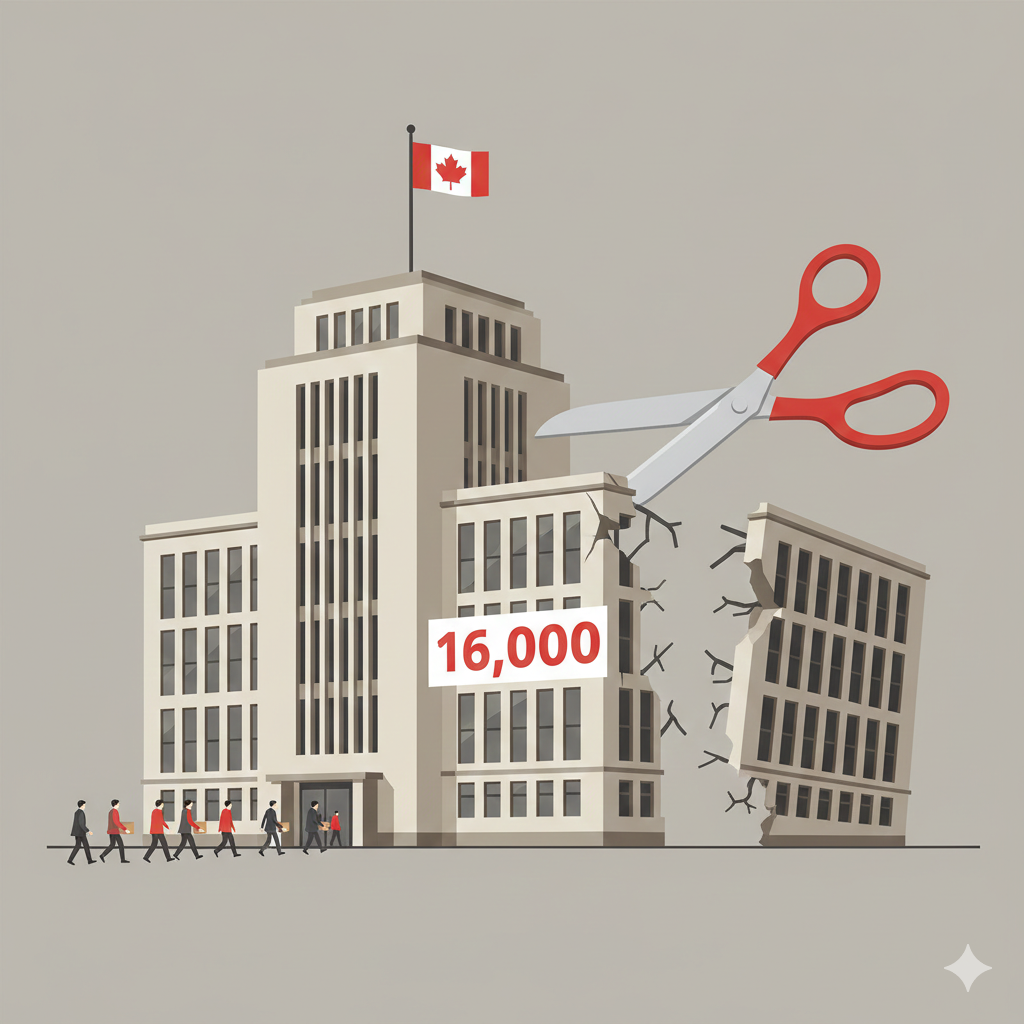
Budget 2025 includes a 15% reduction in federal departments, phased over three years: 7.5% in year one, then 2.5%, then 5%. The result: approximately 16,000 public service positions eliminated, with projected savings of $13 billion annually by 2028-29 [1].
Sounds clean. Sounds decisive. The reality, as always, is messier.
What 16,000 Jobs Looks Like
Canada's federal public service employs roughly 370,000 people [2]. Cutting 16,000 represents about 4.3% of total headcount. The government frames the 15% figure as departmental budget cuts, not headcount cuts specifically. The positions eliminated will come from a mix of attrition (people retiring and not being replaced), voluntary departures, and in some cases, layoffs.
These aren't abstract numbers. They're passport processors in Gatineau. Veterans Affairs case workers in Charlottetown. Immigration officers in Mississauga. Food inspectors in Calgary. Scientists in Ottawa labs. IT support staff scattered across the country.
The government hasn't specified which positions get cut, which is the most important detail and the one that's been conspicuously absent from every announcement. "We're cutting 15%" sounds like a plan. Without knowing which 15%, it's just a number.
The Chretien Precedent
Canada has done this before. In the mid-1990s, Jean Chretien's government eliminated roughly 45,000 public service positions as part of the Program Review, a sweeping deficit reduction exercise that transformed federal finances [3].
It worked, eventually. Canada went from a deficit crisis to a string of surpluses that lasted until the 2008 recession. The fiscal discipline established in that period gave Canada the balance sheet strength that helped it weather the global financial crisis better than most developed countries.
But it also gutted institutional capacity in ways that took over a decade to rebuild. Service Canada wait times ballooned. Veterans Affairs processing times increased. The military, which absorbed significant cuts, ended up deploying underfunded forces to Afghanistan. Scientific capacity at federal laboratories atrophied.
The lesson from the 1990s: cutting government jobs saves money on payroll. Whether it saves money overall depends on what those jobs were doing and what happens when they stop getting done.
The Hidden Costs of Cutting
When you eliminate a government position, the work that position was doing doesn't always disappear. Sometimes it gets absorbed by remaining staff, who become less effective as their workloads increase. Sometimes it gets contracted out to private sector consultants, who typically cost more per hour than the public servants they replaced. Sometimes the work simply doesn't get done, and the consequences show up years later.
Canada's federal government already spends roughly $15-20 billion annually on outside consultants and professional services [4]. One of the consistent criticisms from the Auditor General has been that the government hires consultants to do work that public servants could do more cheaply, then justifies the consultants by saying they lack the internal capacity that they eliminated through previous rounds of cuts.
It's a cycle: cut positions, lose capacity, hire consultants at higher rates, then cut more positions because the payroll budget needs reducing. The net savings are smaller than the headline numbers suggest.
What the Union Says
The Public Service Alliance of Canada (PSAC), which represents most federal workers, has called the cuts "devastating" and argued that they'll result in worse service delivery for Canadians [5].
Unions always oppose job cuts. That's their job. But the PSAC makes a specific argument worth considering: the federal public service was already understaffed relative to the services it's expected to deliver. Passport processing backlogs, immigration delays, and Veterans Affairs wait times all suggest a system operating at or beyond capacity.
Cutting 16,000 positions from a system already showing strain doesn't produce "efficiency." It produces failure. Or it produces a shift to lower-quality service delivery that technically meets benchmarks but leaves citizens frustrated.
The government's counter-argument: the public service grew by roughly 40% under Trudeau, from about 260,000 to 370,000 [6]. There's fat to cut. Many of the positions added during the pandemic era were supposed to be temporary. Making the public service leaner doesn't have to mean making it incapable.
Both sides have a point. The question is execution. Smart cuts that eliminate genuine redundancy while protecting front-line services are possible. Across-the-board percentage cuts that treat every department the same are lazy and often counterproductive.
The 7.5/2.5/5 phasing suggests some thought has gone into the timeline. Whether similar thought goes into the targeting remains to be seen.
Who Gets Cut?
This is where it gets political.
Departments with large regional footprints, Veterans Affairs in Atlantic Canada, Immigration processing centres in Ontario and Quebec, Service Canada offices in rural communities, employ people in ridings that politicians need to win elections.
Cutting Ottawa headquarters staff is easy politics: nobody outside Ottawa feels the pain directly, and cutting "bureaucrats in Ottawa" polls well nationally. Cutting front-line workers in Charlottetown or Sudbury creates local job losses that directly affect communities and voting patterns.
The path of least resistance: cut back-office functions, IT modernization, and policy development positions in the National Capital Region. That saves money, generates fewer political complaints, and is mostly invisible to the public.
The problem: back-office functions exist for reasons. IT modernization delays lead to system failures (see: Phoenix pay system). Policy development capacity determines the quality of future government decisions. Cutting the people who maintain systems and think about problems saves money today and creates crises tomorrow.
The $13 Billion Number
The government projects $13 billion in annual savings by 2028-29 [1]. That number deserves scrutiny.
Total federal payroll is roughly $60-65 billion annually [7]. Cutting 16,000 positions at an average total compensation of $100,000-$120,000 (salary plus benefits plus pension contributions) saves roughly $1.6-1.9 billion per year. The additional savings come from associated overhead: office space, equipment, IT costs, and administrative support that shrinks with headcount.
Getting to $13 billion requires much broader departmental savings beyond just headcount reduction. It implies program cuts, operational efficiency improvements, and reduced spending on everything from travel to professional development.
Thirteen billion dollars represents roughly 4% of total federal spending. It's significant but not unprecedented. It's also the kind of number that looks crisp in a budget document and gets revised downward in subsequent fiscal updates when the implementation gets complicated.
The Bottom Line
Cutting 16,000 public service jobs will save money. How much money, net of the hidden costs, consultant spending, service degradation, and downstream consequences, is genuinely uncertain.
The politics are simple: cutting government looks good. The economics are complicated: cutting government sometimes costs more than keeping it, depending on what you're cutting and how you replace the lost capacity.
Carney is attempting what Chretien accomplished in the 1990s: fiscal discipline through public service reduction. The context is different. Chretien was facing a genuine fiscal crisis with debt-to-GDP ratios threatening Canada's credit rating. Carney is running an $78.3 billion deficit while cutting 16,000 jobs, which is the equivalent of putting a few items back on the shelf while filling two shopping carts.
The cuts signal fiscal discipline. Whether they constitute fiscal discipline is a question that will only be answered by the financial results three years from now.
Until then, if your passport takes a little longer or your immigration application sits in a queue a little deeper, you'll know why.
References
[1] Department of Finance Canada. "Budget 2025: Public Service Modernization." November 2025.
[2] Treasury Board of Canada Secretariat. "Federal Public Service Employment Statistics." 2025.
[3] Paquet, Gilles and Robert Shepherd. "The Program Review: A Deconstruction." 1996.
[4] Parliamentary Budget Officer. "Federal Spending on Professional and Special Services." 2024.
[5] Public Service Alliance of Canada. "Response to Budget 2025 Public Service Reductions." November 2025.
[6] Treasury Board of Canada Secretariat. "Annual Report on Federal Public Service." 2024.
[7] Receiver General for Canada. "Public Accounts of Canada: Personnel Expenditures." 2025.