Published on January 10, 2026
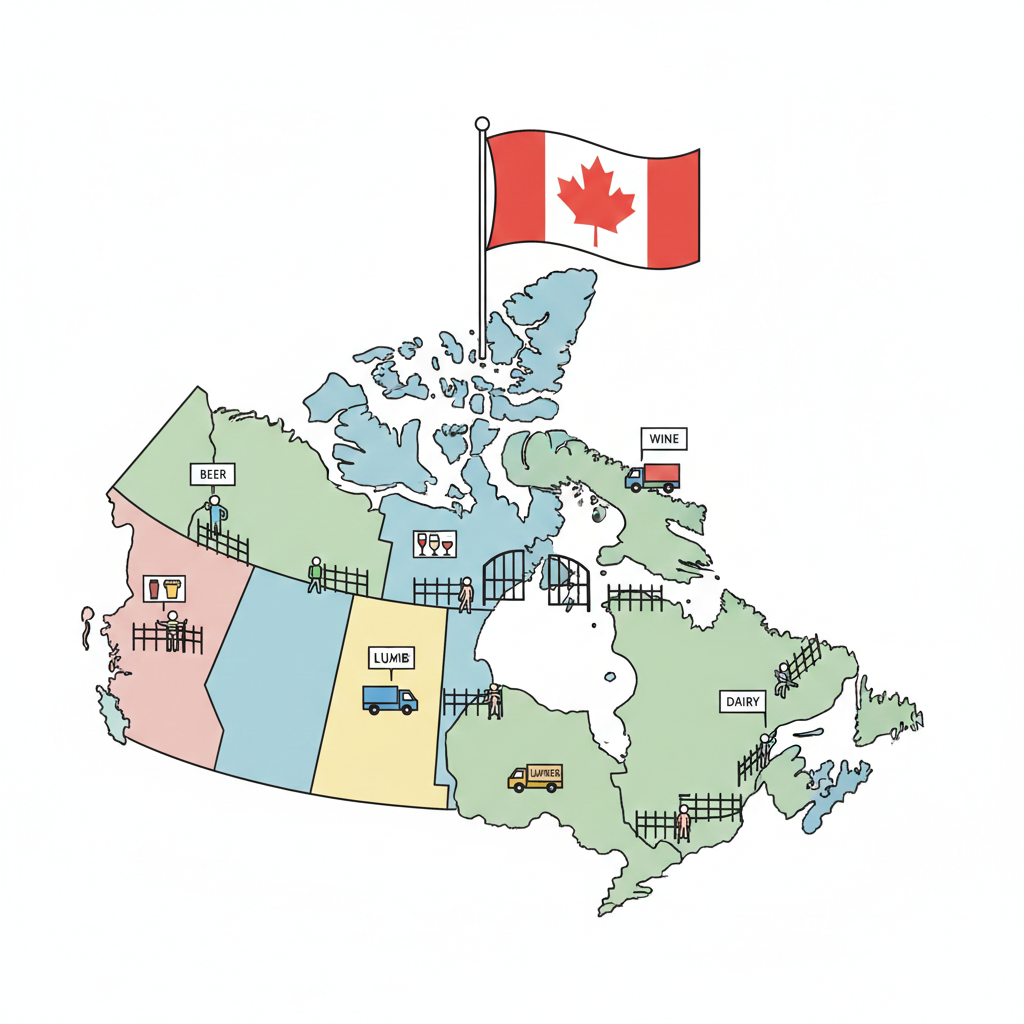
There's something beautifully absurd about a country that negotiates free trade with Europe, Asia, and the Middle East but can't get its own provinces to let a truck full of wine cross from British Columbia to Alberta without paperwork.
Canada has more internal trade barriers than most Canadians realize. A welder certified in Ontario has to recertify to work in British Columbia. A dairy farmer in Quebec faces different regulations than one in Manitoba. A microbrewery in Nova Scotia can't easily sell a case of beer directly to a customer in New Brunswick. We built a country on a railway that was supposed to unite us, then spent 158 years putting invisible fences along the track.
On June 26, 2025, Parliament passed Bill C-5, the One Canadian Economy Act [1]. The name alone should win an award for optimism. The bill removes federal barriers to interprovincial trade and labour mobility, eliminates all federal exemptions under the Canadian Free Trade Agreement, and fast-tracks permitting for major infrastructure projects.
It sounds like it fixes everything. It fixes roughly half of half the problem.
What the Bill Actually Does
Bill C-5 targets the federal government's own trade barriers. There are about 20 key federal exemptions to nationwide free trade that were holding things up [2]. These exemptions allowed Ottawa to maintain different rules for different provinces on things like environmental assessments, transportation regulations, and procurement standards.
The bill strips those exemptions away. A federal regulation that applied differently in Saskatchewan versus Ontario now has to apply the same way everywhere. Infrastructure projects that used to require separate federal approvals in each province can now go through a streamlined national process.
For large-scale projects, this is meaningful. A pipeline, a highway, or a national broadband network that crosses three provincial borders no longer needs three different sets of federal permits. One process, one approval, one set of rules. The time savings on major infrastructure could trim years off project timelines [3].
The labour mobility piece is also straightforward. If you hold a federal certification in one province, it's valid in all provinces. No recertification, no additional paperwork, no paying for exams you've already passed.
What the Bill Doesn't Do
Most internal trade barriers in Canada aren't federal. They're provincial.
The Canadian Free Trade Agreement, signed by all provinces and territories in 2017, was supposed to create a genuine single market [4]. Instead, it created a framework with more exceptions than rules. Each province carved out protections for their pet industries: Quebec protected dairy, Ontario protected auto manufacturing, British Columbia protected wine, Alberta protected energy regulations, and the Atlantic provinces protected fisheries.
Bill C-5 can't touch any of that. The Constitution gives provinces jurisdiction over most of the regulations that actually create trade barriers: professional licensing, product standards, alcohol distribution, agricultural marketing boards, and construction codes.
The Canadian Federation of Independent Business estimated in 2024 that interprovincial trade barriers cost the Canadian economy between $50 billion and $130 billion annually [5]. The federal barriers that Bill C-5 removes represent maybe $10-15 billion of that. Important, but not the revolution the name promises.
Experts have been polite but clear about this limitation. The C.D. Howe Institute called the bill "the start of a conversation" rather than the end of one [6]. Which, in think tank language, means "nice gesture, but the hard part hasn't started."
Why Provinces Keep These Barriers
Provincial trade barriers aren't random bureaucratic silliness. They exist because politicians created them to protect specific groups of voters, and those voters are paying attention.
Quebec's supply management system keeps dairy prices stable for Quebec farmers. Remove it, and cheaper Ontario or American milk floods the market. Quebec dairy farmers go under. Their communities lose jobs. The politicians who allowed it lose elections.
British Columbia's liquor distribution rules protect local wineries and craft breweries from being drowned out by larger Ontario and Alberta producers. Open the market fully, and the Okanagan wine industry faces competition it may not survive.
Alberta's energy regulations are designed for Alberta's specific geological, environmental, and economic conditions. Standardizing them nationally could either water them down (annoying Alberta) or tighten them up (also annoying Alberta).
Every barrier protects someone. The people it protects know exactly who they are and vote accordingly. The people it hurts, which is basically everyone else paying slightly higher prices, don't notice enough to make it an election issue.
This is the core challenge of internal trade reform. The costs of barriers are spread thinly across millions of consumers. The benefits are concentrated among thousands of producers. In politics, concentrated interests almost always beat diffuse ones. That's not corruption. It's just math.
The Beer Example
Nothing illustrates Canada's internal trade absurdity better than beer.
In 2012, Gerard Comeau, a New Brunswick man, was fined for buying beer and liquor in Quebec and driving it home across the provincial border [7]. He took the case all the way to the Supreme Court, arguing that the Constitution's Section 121, which says goods should be "admitted free" across provincial boundaries, should mean exactly what it says.
The Supreme Court disagreed. In a 2018 ruling, they decided that "admitted free" doesn't actually mean free of restrictions, just free of tariffs [8]. Provinces can restrict how much alcohol you bring across borders, require you to buy from provincial monopoly stores, and generally treat interprovincial booze like international contraband.
That's the legal framework Bill C-5 operates within. The Constitution, as interpreted by the Supreme Court, gives provinces wide latitude to maintain internal trade barriers. Federal legislation can remove federal barriers, but it can't override provincial jurisdiction without a constitutional amendment.
And constitutional amendments in Canada are roughly as easy as getting all your relatives to agree on a restaurant.
What It Means for Workers
The labour mobility improvements in Bill C-5 are probably the most immediately useful part of the legislation.
Right now, a nurse licensed in Alberta who wants to work in Ontario has to navigate a different licensing process, potentially retake exams, and wait months for approval [9]. A construction worker certified as a journeyman electrician in British Columbia may need additional credentials to work on a job site in Quebec.
These barriers hurt workers and make labour shortages worse. Canada has simultaneous surpluses of workers in some provinces and shortages in others, partly because moving between provinces for work involves bureaucratic hassle that makes the job switch not worth the trouble.
Bill C-5 eliminates the federal layer of that hassle. If your credentials are federally recognized, they're recognized everywhere. The provincial layer, which is often the thicker one, remains unchanged.
The real test will be whether the provinces follow the federal lead. Several have signalled willingness to harmonize professional licensing. Others have been quiet, which in Canadian federalism usually means "not a chance."
The Bottom Line
Bill C-5 is a real piece of legislation that solves a real part of a real problem. It strips away federal trade barriers that never should have existed, streamlines infrastructure permitting, and improves labour mobility for federally regulated professions.
It is not, despite its name, the creation of "one Canadian economy." The barriers that cost Canadians the most, the provincial regulations that fragment our market into ten separate fiefdoms, remain untouched. Fixing those requires provincial cooperation that no federal bill can compel.
Carney deserves credit for doing what he can within federal jurisdiction. He doesn't deserve credit for pretending that's the whole job.
Canada's internal trade mess is a problem that's been obvious for decades and intractable for exactly as long. Every prime minister since at least Mulroney has talked about fixing it. None have fully succeeded. The Constitution makes it hard. Provincial politics make it harder. And the average Canadian, who pays more for groceries, housing, and consumer goods because of invisible interprovincial walls, doesn't even realize there's a fence.
Until they try to buy beer in New Brunswick. Then they notice.
References
[1] Parliament of Canada. "Bill C-5: One Canadian Economy Act." Royal Assent June 26, 2025.
[2] Canadian Free Trade Agreement Secretariat. "Federal Exemptions to Interprovincial Trade." 2025.
[3] Infrastructure Canada. "Streamlined Permitting Framework for National Projects." 2025.
[4] Canadian Free Trade Agreement. Full text and annexes. 2017.
[5] Canadian Federation of Independent Business. "Interprovincial Trade Barriers: Updated Cost Estimates." 2024.
[6] C.D. Howe Institute. "Analysis of Bill C-5: Federal Internal Trade Reform." Commentary. 2025.
[7] CBC News. "Gerard Comeau's beer fight reaches Supreme Court." 2018.
[8] Supreme Court of Canada. "R. v. Comeau." 2018 SCC 15.
[9] Canadian Nurses Association. "Interprovincial Licensing Barriers Report." 2024.