Published on December 20, 2025
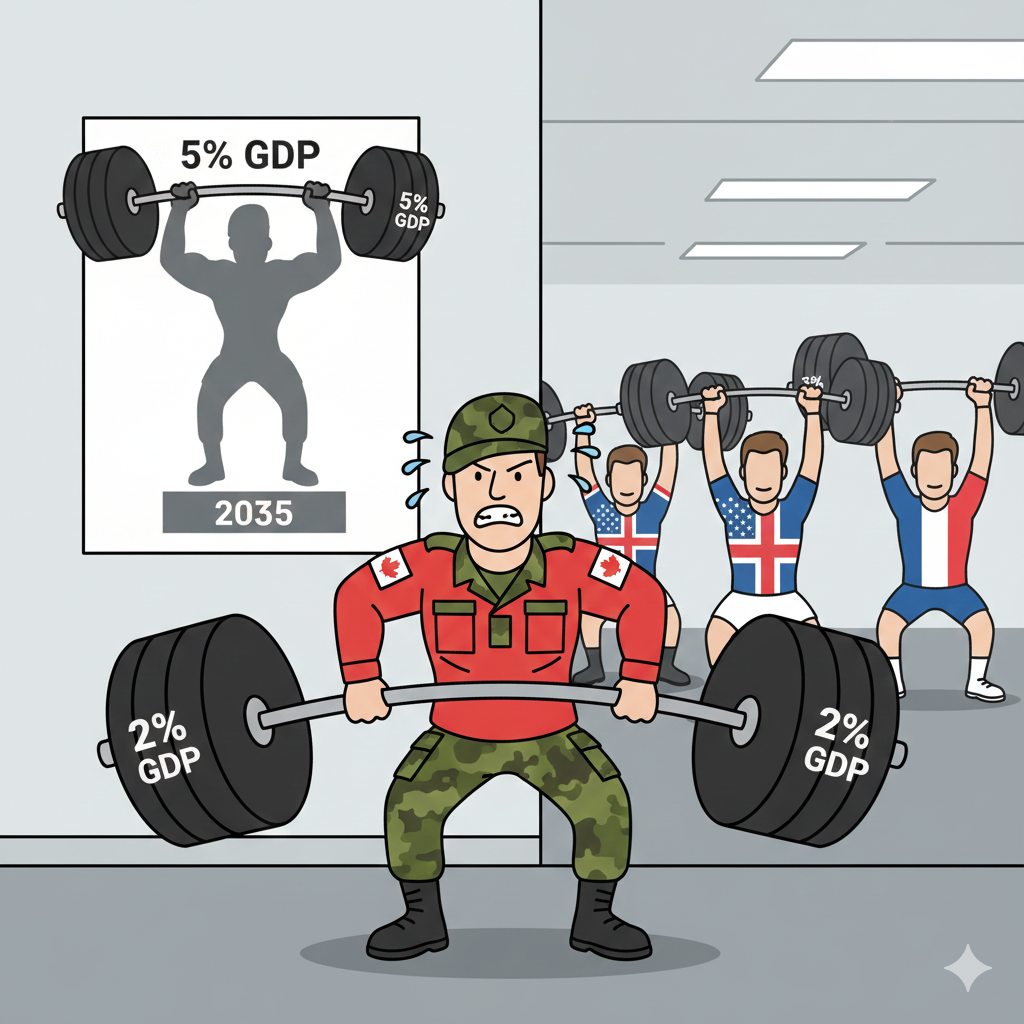
For most of my adult life, Canada's relationship with military spending has been like that friend who always says they'll start going to the gym next month. NATO has been asking us to spend 2% of GDP on defence since 2006. We've been nodding politely and spending about 1.3% [1]. Sometimes less. We'd show up to NATO summits, promise to do better, then go home and buy some used submarines that don't work properly.
That era appears to be over.
In June 2025, Carney committed to reaching the 2% NATO spending target by March 2026, five full years ahead of the original schedule. The cash increase: $9.3 billion in additional defence spending for 2025-26 alone. Budget 2025 included $81.8 billion in defence investment described as a sovereignty "blueprint" [2]. And then, almost casually, Canada pledged to reach NATO's new 5% of GDP target by 2035 [3].
Five percent of GDP on defence. For Canada. The country whose military jokes are a genre unto themselves.
To put 5% in perspective: Canada's GDP is roughly $2.2 trillion. Five percent is $110 billion per year on defence. That's more than the current budgets for healthcare transfers, education support, and social programs combined. It's roughly what the United States spends per capita on its military, adjusted for exchange rates.
Even if we only hit 2%, that's $44 billion annually, which is nearly double what we spent in 2024.
Where Did This Come From?
Three things changed at once.
First, Trump. When the US president starts publicly musing about annexing Canada and calling it the "51st state," the political case for military independence gets a lot easier to make. Hard to argue that we don't need our own defence capabilities when the country that's supposed to defend us is the one making threats.
Second, Ukraine. Russia's invasion proved that territorial warfare between modern nations isn't a relic of the 20th century. European NATO members responded by dramatically increasing their own spending. Canada was the obvious laggard. Being the only G7 country not meeting the 2% target while a war rages in Europe is an embarrassing look at international summits.
Third, Carney himself. As a former central banker with deep connections to European financial and political institutions, he understood that Canada's credibility as a partner in the new middle-power alliance depended on demonstrating seriousness about defence. You can't ask Germany and France to build trade partnerships with you while freeloading on their military contributions to NATO.
The result: Canada went from decades of underspending to the most aggressive defence spending increase in the country's peacetime history.
Can We Even Spend It?
This is the question that doesn't get enough attention. Canada's defence procurement system has a legendary reputation for inefficiency, delays, and cost overruns. The system that took 30 years and several billion dollars to not replace our fighter jets is now being asked to absorb an additional $9.3 billion in a single year.
The Canadian Forces have been operating with roughly 100,000 regular and reserve personnel, well below their authorized strength [4]. Equipment is aging. The navy's frigates are decades old. The air force has been flying CF-18 fighters since the 1980s. Army vehicles need replacement across nearly every category.
Spending money on defence requires people to spend it on. That means procurement officers who can write contracts, military personnel who can operate new equipment, and an industrial base that can build what's needed.
Canada's defence industrial base is real but small. Companies like General Dynamics Land Systems in London, Ontario, Irving Shipbuilding in Halifax, and L3Harris in various locations build military equipment, but their capacity is limited [5]. Scaling up production takes time and investment of its own.
The most likely outcome in the short term: a lot of the new money goes to buying equipment from other countries rather than building it domestically. That creates military capability quickly but doesn't generate the industrial jobs and economic multipliers that come from domestic manufacturing.
The Procurement Diversification Angle
Carney made an interesting pledge alongside the spending increase: Canada will stop sending "three-quarters of defence capital spending to America" and will diversify procurement toward Europe [6].
This isn't just about getting better prices. It's part of the broader trade diversification strategy. By buying military equipment from European allies, Canada deepens its economic relationships with the EU while reducing dependence on American defence contractors.
Canada also joined SAFE, the European defence procurement arrangement, which gives Canadian companies access to European defence contracts and vice versa [7].
The strategic logic is sound: if you're building a middle-power alliance with European countries, buying their military equipment strengthens the relationship and creates mutual economic dependencies. A European country that sells Canada billions in defence hardware has a financial stake in maintaining good relations with Canada.
But European defence equipment isn't always interoperable with American systems, and NORAD, Canada's joint air defence agreement with the US, requires significant coordination with American military technology. Switching suppliers isn't as simple as picking a different catalogue.
Ukraine: $2 Billion and Counting
Separately from the NATO spending increase, Canada allocated $2 billion in military assistance to Ukraine and reaffirmed the commitment during meetings with President Zelensky [8].
Two billion dollars in military aid is significant for Canada, though modest compared to US contributions. The money goes to military equipment, training, and support for Ukrainian forces.
The ethical case for the aid is straightforward: a democratic country was invaded by a larger neighbour. Supporting its defence aligns with every principle of international law and Canadian values that the government articulates.
The economic case is more nuanced. Military aid is government spending that generates domestic economic activity if the equipment is sourced from Canadian manufacturers. Some of it is. But much of the aid involves transferring existing Canadian military equipment, which then needs to be replaced, feeding back into the procurement cycle.
What $81.8 Billion Buys
The Budget 2025 defence figure of $81.8 billion over several years breaks down roughly into three categories [2].
Equipment modernization: replacing aging platforms across all three services. New fighter jets (the F-35 procurement is finally moving forward after decades of debate), new naval vessels through the National Shipbuilding Strategy, and new armoured vehicles for the army.
Personnel: recruiting, training, and retaining military members. The Canadian Forces have been struggling with recruitment for years. Military pay, housing, and quality of life all need investment to attract people to a career that involves moving every few years, deploying to difficult places, and accepting restrictions on personal freedom that most Canadians wouldn't tolerate.
Infrastructure: bases, training facilities, and the physical plant that supports military operations. Much of it is aging and needs either major renovation or replacement.
The honest reality is that $81.8 billion over five to seven years doesn't fully address decades of underinvestment. It's a significant down payment. Getting to a sustained 2% of GDP, let alone 5%, requires annual defence budgets well above current levels for the foreseeable future.
The Opportunity Cost
Every dollar spent on defence is a dollar not spent on something else. At current spending levels, the trade-offs were manageable. At 2% of GDP, they become visible. At 5%, they become the dominant feature of federal budgeting.
Canada currently spends roughly 6% of GDP on healthcare (federal and provincial combined), 5% on education, and 1.3% on defence [9]. Moving defence to 2% means either raising revenue, cutting other spending, or running larger deficits. Moving to 5% means all three, at scale.
The government hasn't fully reckoned with this trade-off publicly. Budget 2025 absorbed the initial increase within its broader $141 billion spending plan, but the path to 5% by 2035 implies annual defence budgets that would crowd out significant amounts of domestic spending.
This is the calculation that Canadians will eventually have to make: how much are we willing to spend on military capability versus healthcare, housing, education, and social programs? The answer has been "not much" for three generations. Carney is betting that the geopolitical environment has changed enough to shift that answer.
He might be right. The world looks a lot more dangerous than it did five years ago.
The Bottom Line
Canada is buying a military. Not the world-class, power-projecting kind, but something significantly more capable than the modest force we've maintained since the Cold War ended.
The spending is historic. The challenge is execution. Canada's defence procurement system needs to absorb more money, more quickly, and more efficiently than it's ever managed before. That's a bigger transformation than the budget numbers suggest.
Whether this spending makes Canada safer, strengthens our international partnerships, and delivers value for taxpayers depends entirely on whether we can actually build the things the money is supposed to buy. Given our track record with submarines, that's not a question with an obvious answer.
But at least we're in the gym now. The question is whether we know how to use the equipment.
References
[1] NATO. "Defence Expenditure of NATO Countries (2014-2025)." June 2025.
[2] Department of Finance Canada. "Budget 2025: Defence and Sovereignty Investments." November 2025.
[3] Prime Minister of Canada. "Canada's Commitment to NATO 5% Target." June 2025.
[4] Department of National Defence. "Canadian Armed Forces Strength and Recruitment." 2025.
[5] Canadian Association of Defence and Security Industries. "Industry Capability Assessment." 2025.
[6] Prime Minister of Canada. "Defence Procurement Diversification." 2025.
[7] European Defence Agency. "SAFE Partnership Framework." 2025.
[8] Prime Minister of Canada. "Canada's Military Assistance to Ukraine." 2025.
[9] OECD. "Government Expenditure by Function: Canada." 2024.