Published on January 5, 2026
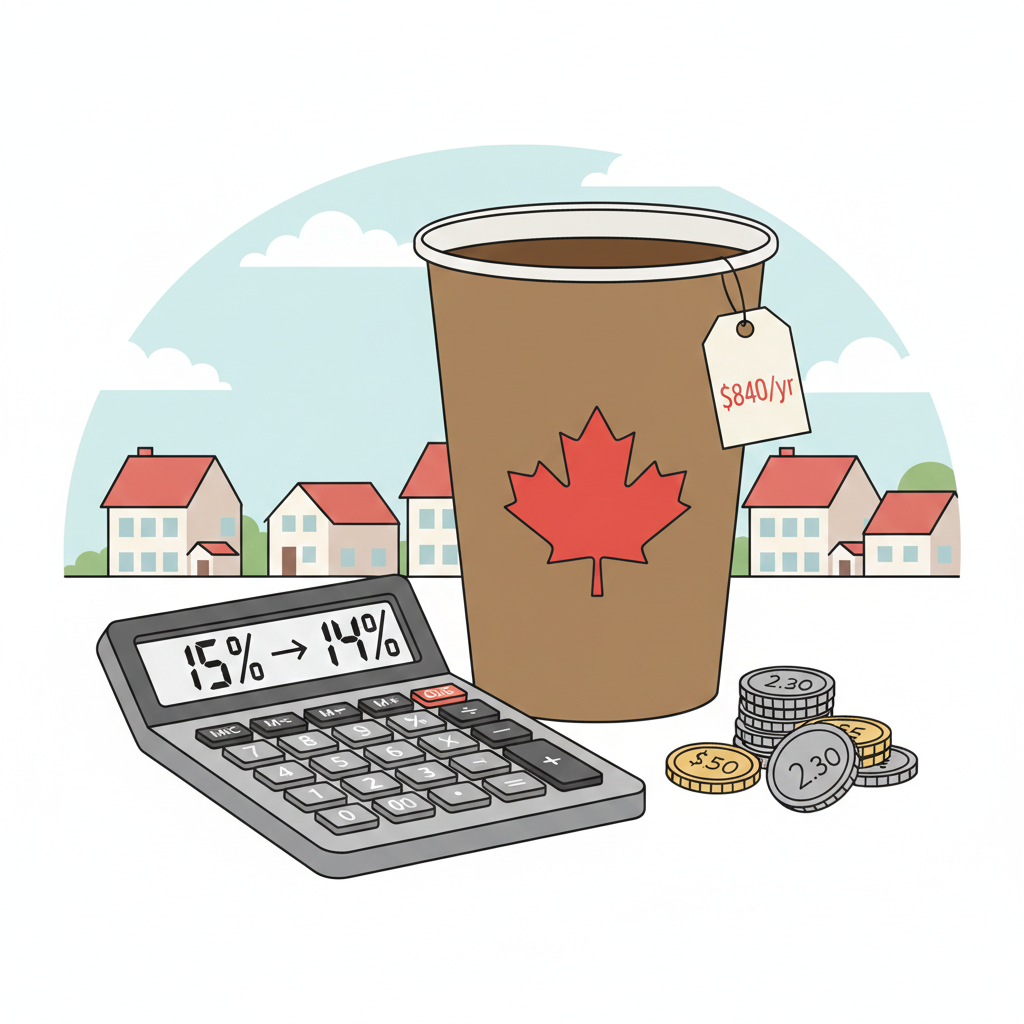
On July 1, 2025, the bottom federal income tax rate dropped from 15% to 14% [1]. Happy Canada Day, here's a tax cut.
If you earn a salary, you noticed. If you pay attention to your paycheque stub (and honestly, who does anymore), the federal tax deduction got a tiny bit smaller. A two-income household saves roughly $840 per year. A single earner saves about $420 [2].
That's about $2.30 a day for a couple. Enough for one Tim Hortons medium coffee each. Grab a double-double, put the change in a jar, and by December you'll have enough to buy... well, another year's worth of daily coffees.
The government says 22 million Canadians benefit [2]. That's true. Everyone with taxable income above zero gets a slightly smaller tax bill. The question isn't whether the cut helps. It does. The question is whether it helps enough to matter, and what it costs on the other side of the ledger.
How It Works
Canada's federal income tax system has five brackets. The bottom one covers the first $55,867 of taxable income [3]. That's the bracket that went from 15% to 14%.
Every Canadian taxpayer benefits from this cut, because everyone's first $55,867 is taxed at the lower rate regardless of total income. A teacher earning $65,000 saves the full amount. A surgeon earning $400,000 also saves the full amount, because their first $55,867 is also taxed at 14% instead of 15%.
The maximum saving per person is $558.67 (1% of $55,867) [3]. For a two-income household where both partners earn above that threshold, the combined saving is roughly $1,117, though the government rounds to $840 after accounting for clawbacks on certain income-tested benefits [2].
This is a flat-dollar benefit. Everyone saves the same amount in tax, regardless of income. A single parent earning $40,000 saves the same dollars as a Bay Street lawyer earning $400,000. In percentage terms, the parent's saving is much more significant. In absolute terms, it's identical.
Progressive tax policy purists would point out that targeting the cut differently, say, through an enhanced basic personal amount or a refundable credit, could have delivered more benefit to lower earners and less to higher ones. But that's more complex to administer and harder to explain in a press conference. "We cut your tax rate" fits on a bumper sticker. "We restructured the basic personal amount with income-tested phase-outs" does not.
The Deficit Context
That $840 feels different when you set it next to the $78.3 billion deficit in Budget 2025 [4].
Canada has roughly 20 million income tax filers [5]. The tax cut costs the treasury approximately $7-8 billion in foregone revenue per year. That revenue has to come from somewhere: either additional borrowing, spending cuts elsewhere, or the hope that economic growth generates enough new tax revenue to fill the gap.
The government's position is that the growth generated by the broader $1 trillion investment plan will more than compensate for the lost tax revenue. That's the kind of argument that sounds reasonable in a budget speech and impossible to verify until it either works or doesn't, years from now.
Meanwhile, each Canadian's share of the national debt continues to climb. Federal debt sits around $1.4 trillion [6]. Divide that by 40 million Canadians and you get roughly $35,000 per person. The annual interest payment on that debt exceeds $50 billion, which is more than the government transfers to provinces for healthcare [7].
Your $840 tax cut is real money in your pocket. Your share of the additional deficit spending is larger money on a credit card you can't cancel. Both things are true at the same time.
What $840 Actually Buys
Put the savings in concrete terms for a typical Canadian household.
Eighty-four dollars a month covers about two weeks of groceries for a single person in a mid-size Canadian city [8]. Or one month of a basic phone plan. Or two tanks of gas in a compact car. Or half a monthly transit pass in Toronto.
It doesn't cover a mortgage payment. It doesn't cover childcare. It doesn't cover the increase in food prices that most Canadians have experienced since 2022. Canada's Food Price Report estimated that the average family spent $16,297 on food in 2025, an increase of roughly $700 from the year before [9].
So the tax cut gives back $840 while food costs alone went up by $700. Net gain: $140, or about three trips to the grocery store.
This isn't the government's fault specifically. Inflation is driven by global factors, supply chains, energy prices, and commodity markets that no single country controls. But it does frame the tax cut in its proper context: a modest benefit that partially offsets rising costs rather than a transformative change in household finances.
Historical Comparison
Tax cuts come and go in Canadian politics. This one fits a familiar pattern.
Stephen Harper cut the GST from 7% to 5% over two terms, saving households roughly $1,000-$1,500 per year depending on spending patterns [10]. Economists almost universally criticized the GST cut as inefficient (consumption taxes are less distortionary than income taxes), but voters loved it because they saw the savings every time they bought something.
Justin Trudeau raised the middle-class income tax bracket from 22% to 20.5% in 2016, while raising the top bracket to 33% [11]. Net effect for middle-income earners: a few hundred dollars per year. The redistribution was modest but directional.
Carney's cut is the first reduction to the bottom bracket in decades. It's smaller in dollar terms than Harper's GST cut but reaches more people. It's also less controversial than Trudeau's bracket reshuffling because there's no offsetting increase on higher earners.
The pattern across all three: tax cuts popular enough to announce, modest enough that they don't fundamentally change anyone's financial situation, and expensive enough that the lost revenue matters to the national balance sheet.
Who Benefits Most?
The honest answer: higher earners benefit more in absolute terms because they're more likely to have two incomes above $55,867 and fewer income-tested benefit clawbacks. Lower earners benefit more in relative terms because $840 is a larger percentage of a $40,000 income than a $200,000 income.
The Canada Child Benefit, the GST/HST credit, and several provincial programs are income-tested, meaning that as your income changes, your benefits adjust. A small reduction in taxable income can increase eligibility for these programs for some lower-income households, creating a compound benefit that's hard to calculate precisely but real.
For retirees on fixed incomes, the cut helps but modestly. CPP and OAS payments are taxable at the new lower rate. A retiree with $30,000 in taxable income saves about $300 per year.
For students and part-time workers with very low incomes, the savings are minimal because they were paying very little federal tax to begin with.
The tax cut works. It just works quietly. Nobody's financial life changes because of it. Nobody goes from struggling to comfortable because their tax rate dropped one percentage point. It's the kind of policy that's easy to defend and hard to get excited about.
The Bottom Line
Fourteen percent is lower than fifteen percent. That is, mathematically, a tax cut. It puts money back in your pocket. Not a lot. But some.
The bigger question is whether a government can simultaneously cut taxes, increase spending by $141 billion, and run a $78 billion deficit without eventually making the math stop working. The answer to that question won't be clear for years, and when it becomes clear, the politicians who made the decisions will likely have moved on to other things.
For now, enjoy your daily coffee. On the government, sort of. Through slightly reduced tax withholding on your biweekly pay. Which you probably won't notice unless you check your stub.
Which you should. More often. Seriously.
References
[1] Department of Finance Canada. "Tax Measures: Budget 2025." November 2025.
[2] Department of Finance Canada. "Income Tax Rate Reduction: Distributional Analysis." 2025.
[3] Canada Revenue Agency. "Federal Income Tax Rates for 2025-2026." 2025.
[4] Department of Finance Canada. "Budget 2025: Fiscal Overview." November 2025.
[5] Canada Revenue Agency. "Income Statistics: T1 Final Basic Table." 2024.
[6] Department of Finance Canada. "Fiscal Reference Tables." 2025.
[7] Parliamentary Budget Officer. "Federal Debt Servicing Costs." 2025.
[8] Statistics Canada. "Monthly Average Food Expenditure for One Person." 2025.
[9] Dalhousie University. "Canada's Food Price Report 2025." December 2024.
[10] Department of Finance Canada. "GST/HST Rate History." 2006-2008.
[11] Department of Finance Canada. "Tax Changes for 2016: Middle Class Tax Cut." 2015.