Published on July 1, 2025
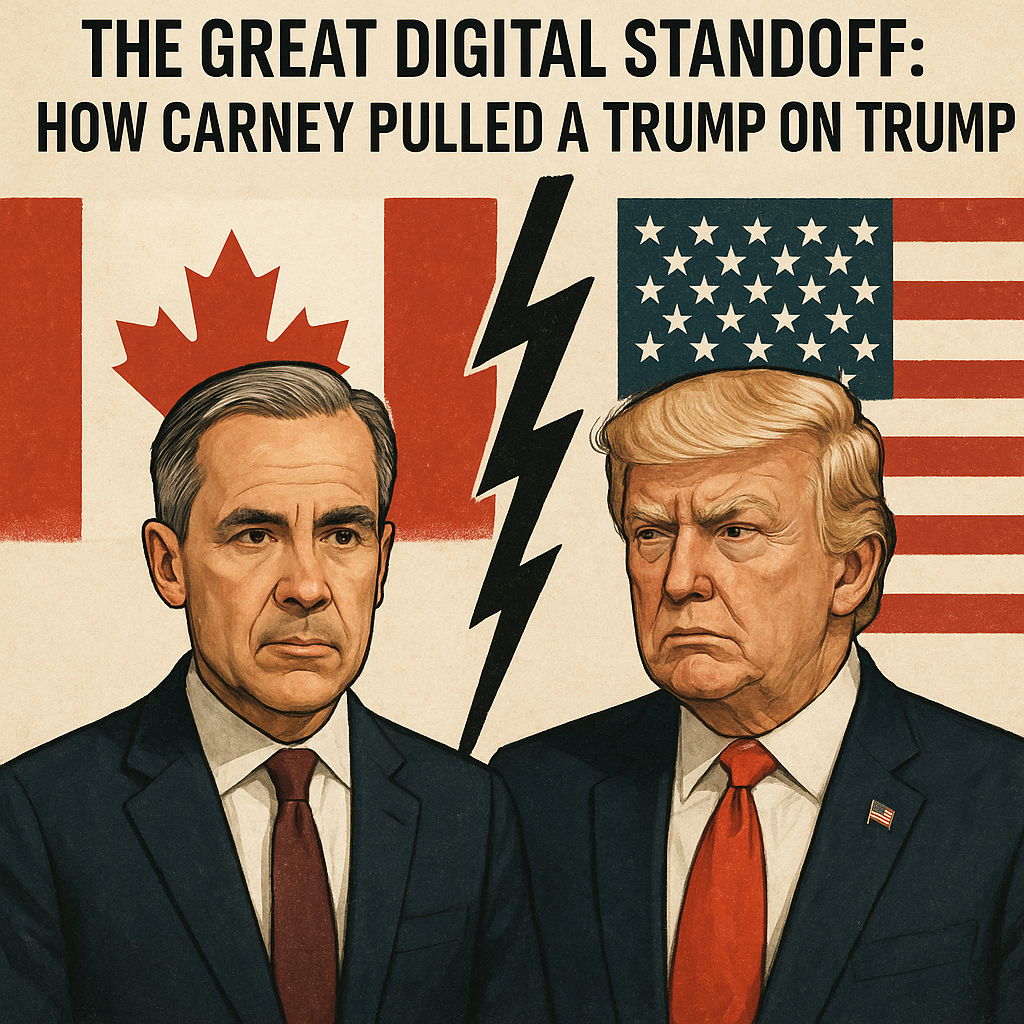
Bottom Line Up Front: Prime Minister Mark Carney executed a masterful economic chess move Sunday night, rescinding Canada's Digital Services Tax just hours before the first $2 billion payment was due, demonstrating that sometimes the boldest strategy is knowing exactly when to fold. What looked like a capitulation was actually vintage Carney. The same strategic thinking that guided him through the 2008 financial crisis and Brexit negotiations.
In the most Canadian way possible, our new PM just schooled the master of "Art of the Deal" by doing what Trump himself perfected: creating maximum pressure, then pivoting at precisely the right moment to secure the best outcome. The White House immediately declared victory, with press secretary Karoline Leavitt crowing that "Prime Minister Carney in Canada caved to President Trump". Missing entirely that Carney just secured everything he wanted while looking like the reasonable statesman.
But here's the deeper game: this digital tax drama was never really about the $2-3 billion in revenue. It was about establishing Canada's digital sovereignty credentials and negotiating position for the comprehensive economic and security partnership that's now back on track for the July 21 deadline set at the G7 Summit. Carney understood something Trump's team didn't. That the real prize wasn't the tax, but the broader localization revolution that this crisis has accelerated.
The Art of the Strategic Reversal
Sunday night's announcement came after President Trump declared he was "terminating ALL discussions on Trade with Canada" and threatened new tariffs within seven days. Classic Trump pressure tactics, except this time, he was dealing with someone who wrote the playbook on crisis management during his years steering monetary policy through global financial storms.
Carney's statement was perfectly calibrated: "Today's announcement will support a resumption of negotiations toward the July 21, 2025, timeline set out at this month's G7 Leaders' Summit in Kananaskis". Notice the framing. This wasn't backing down, it was strategic timing to advance the bigger deal. Finance Minister François-Philippe Champagne reinforced the message: "Rescinding the digital services tax will allow the negotiations of a new economic and security relationship with the United States to make vital progress".
The beauty of the move? Carney "has been clear that Canada will take as long as necessary, but no longer, to achieve that deal". Translation: we'll play nice to get negotiations restarted, but don't mistake tactical flexibility for strategic weakness.
What makes this vintage Carney is the sophisticated understanding of negotiating power. The Digital Services Tax Act applied retroactively to 2022 and would have collected approximately $2 billion from US tech giants, but its real value was as a negotiating chip. By deploying it when Trump was at his most combative, then withdrawing it at the perfect moment, Carney demonstrated he understands both pressure and release. The hallmarks of effective statecraft.
The White House immediately celebrated the reversal, with press secretary Karoline Leavitt declaring "Prime Minister Carney in Canada caved to President Trump and the United States of America". Commerce Secretary Howard Lutnick added: "Thank you Canada for removing your Digital Services Tax which was intended to stifle American innovation and would have been a deal breaker for any trade deal with America". Missing entirely that this was exactly the outcome Carney orchestrated.
The Localization Revolution Continues Regardless
While Washington celebrates tactical victory, the broader economic transformation toward localization continues accelerating, with or without Canada's digital tax. The crisis has validated that digital policies are powerful tools for economic sovereignty, inspiring other middle powers globally while demonstrating that comprehensive trade relationships can be restructured around regional priorities.
McKinsey's 2024 research shows 64% of companies are actively regionalizing their supply chains, driven by geopolitical tensions that the Canada-US digital tax standoff perfectly exemplified. The economic theory supporting localization remains rock-solid: local sourcing reduces costs by 15-25%, creates multiplicative job effects generating 2.5-5 additional local positions for each primary job, and provides crucial supply chain stability.
Mexico's emergence as America's largest trading partner illustrates these trends. US imports from Mexico grew from $320 billion to $402 billion (+26%) since the pandemic, while China's trade relationship declined. This "friend-shoring" phenomenon. 83% of organizations are investing in politically aligned trading partners, creates the exact conditions where Canada can thrive under a comprehensive new economic partnership.
The digital sovereignty movement extends far beyond Canada. Approximately 25+ countries have implemented or proposed digital services taxes, from EU members to developing economies like Argentina, India, Brazil, Indonesia, Kenya, Nigeria, and Vietnam. The OECD's multilateral approach has effectively failed, meaning bilateral and regional solutions, exactly what Carney is negotiating, represent the future of digital trade governance.
Canada's Strategic Infrastructure Investment Pays Dividends
The real genius of Canada's digital strategy becomes clear when you examine the broader investment portfolio that the Digital Services Tax was designed to fund. The $2 billion Canadian Sovereign AI Compute Strategy, $300 million AI Compute Access Fund for SMEs, and $240 million investment in Cohere Inc. represent comprehensive efforts to build local AI and digital infrastructure capacity.
These investments create what economists call "infant industry protection" for digital sectors, temporary advantages that allow local companies to develop competitive capabilities. Data localization requirements force cloud services and data centers to locate domestically, creating immediate infrastructure investment and job creation, while local content mandates require minimum quotas for domestic digital content.
Canada's approach combines digital taxation with substantial strategic investments in domestic capabilities, creating self-reinforcing cycles of technological development and economic sovereignty. The Digital Services Tax was never just about revenue. It was about establishing the policy framework and financial resources for comprehensive digital independence.
Now, with negotiations restarted and the broader economic partnership on track, Canada can pursue these goals through cooperative frameworks rather than unilateral taxation. That's not capitulation. That's strategic optimization.
The Multiplier Effects of Smart Trade Strategy
Economic research validates Carney's approach through well-documented multiplier mechanisms. Studies by economist Enrico Moretti demonstrate that each skilled job created generates 2.5 additional local jobs, while technology jobs create 5 non-tradable jobs locally. McDonald's global localization success story, international sales account for 59% of total revenue while local sourcing reduced operational costs by 15-25% in key markets, illustrates how comprehensive regional strategies deliver superior outcomes.
Hyundai's success in India versus Volkswagen's struggles provides another compelling case study, with Hyundai achieving 17% market share through comprehensive local supplier ecosystems while Volkswagen struggled to less than 1% market share. These patterns repeat across sectors: local businesses recirculate 2-4 times more money locally than chain stores, creating self-reinforcing cycles of regional economic development.
The semiconductor industry showcases regionalization's strategic importance. US manufacturing employment has surpassed pre-pandemic levels at 13 million, with construction spending in manufacturing nearly tripling since June 2020 to reach a record $225 billion in January 2024. The CHIPS Act has catalyzed $430 billion in announced clean technology and semiconductor investments through 2031, creating comprehensive domestic capabilities in critical technology sectors.
Why Carney's Gambit Will Define the Next Decade
The strategic brilliance of Carney's Digital Services Tax deployment and withdrawal lies in its perfect timing and comprehensive understanding of North American economic integration. By creating maximum pressure at the moment when Trump was most committed to combative trade policies, then offering a path to partnership exactly when negotiations needed restarting, Canada demonstrated sophisticated statecraft that accomplishes multiple objectives simultaneously.
First, it established Canada's willingness to assert digital sovereignty, sending a clear signal to both Washington and other middle powers that economic autonomy is achievable even against superpower opposition. Second, it generated international precedent for digital taxation as a legitimate policy tool, encouraging similar policies across the G20 despite US objections. Third, it created the crisis necessary to restart comprehensive trade negotiations that had stalled under traditional frameworks.
Most importantly, it positioned Canada as the reasonable partner in North American economic integration while maintaining policy autonomy over digital governance, infrastructure investment, and technological development. The comprehensive economic and security partnership now under negotiation will likely include provisions for Canadian digital sovereignty that would have been impossible to secure through traditional trade discussions.
The broader "glocalization" trend, combining global connectivity with regional resilience, appears irreversible given mounting geopolitical tensions, supply chain vulnerabilities, and environmental imperatives. Organizations that proactively embrace comprehensive localization strategies while maintaining strategic global connections will be best positioned to thrive in this new economic reality.
The Carney Doctrine: Strategic Flexibility for Economic Sovereignty
What we witnessed Sunday night wasn't capitulation. It was the emergence of the "Carney Doctrine" for middle power economic strategy in the age of digital sovereignty and supply chain regionalization. The doctrine combines tactical flexibility with strategic persistence, using crisis creation and resolution to advance long-term national interests while maintaining constructive relationships with essential partners.
The immediate resumption of trade talks, with economic adviser Kevin Hassett confirming "Absolutely" when asked about negotiations restarting, validates the approach. Canada secured everything it wanted: established digital sovereignty credentials, advanced comprehensive partnership negotiations, and maintained its position as an essential North American ally, all while looking like the mature, reasonable partner in the relationship.
The deeper transformation toward supply chain regionalization, digital infrastructure investment, and economic sovereignty continues regardless of any individual policy instrument. With 73% of companies reporting progress on dual-sourcing strategies and Mexico receiving $29 billion in foreign direct investment in the first half of 2023 alone, the structural changes favoring regional economic integration are accelerating.
For other middle powers watching this drama unfold, the lesson is clear: digital sovereignty strategies are viable despite superpower opposition, but success requires sophisticated timing, comprehensive partnership frameworks, and the strategic wisdom to know when maximum pressure becomes optimal cooperation.
Carney didn't pull a Trump on Trump by accident. He did it because he understands that in the modern economy, the most powerful move is often knowing exactly when to appear to fold while actually securing everything you came to win. That's not just good economics. It's genius-level statecraft that will define Canada's prosperity for decades to come.
Sir Looniesworth predicted this exact scenario in his analysis of Mark Carney's leadership style during the central banking years, strategic patience combined with perfectly timed decisive action. As he noted then, "Never mistake Canadian politeness for Canadian weakness. We've been playing this game since 1867, and we're really quite good at it."