Published on March 20, 2025
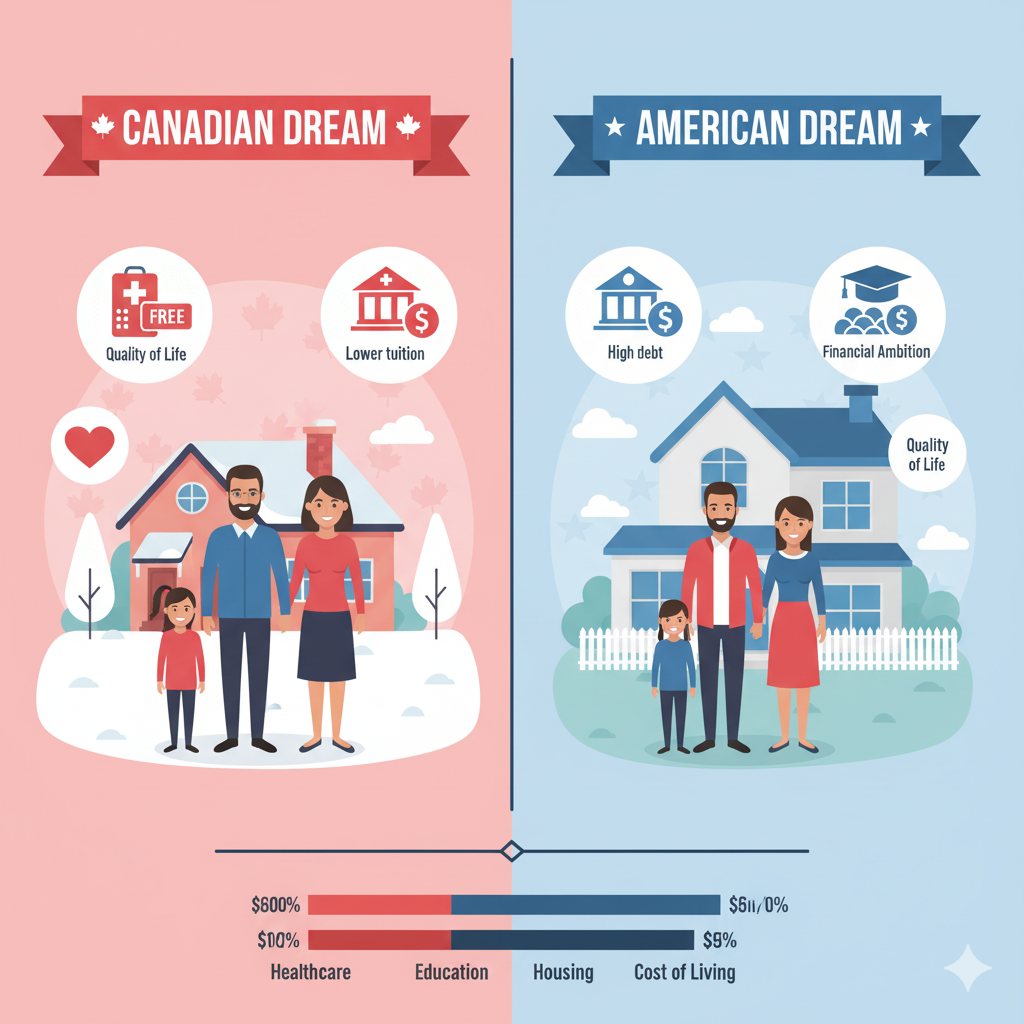
Picture two families: the Johnsons in Minneapolis and the Martins in Winnipeg. Both have household incomes around $75,000, two kids, and middle-class aspirations. Both work hard, save responsibly, and dream of providing better opportunities for their children.
Yet their economic realities, from healthcare costs to education expenses to retirement security, differ dramatically. Understanding these differences reveals fundamental distinctions between the Canadian and American approaches to middle-class prosperity.
What You Earn and Keep
According to Statistics Canada, the median Canadian household income is approximately $84,000 CAD¹. In the United States, the Census Bureau reports median household income of $70,000 USD², which converts to roughly $95,000 CAD. So Americans earn more, right? Not quite. After accounting for taxes and essential services, the picture becomes more complex.
That Canadian family earning $84,000 takes home approximately $64,000 after federal and provincial taxes in Ontario³. The American family earning $70,000 USD keeps about $55,000 after federal and state taxes in a typical state⁴. But the Canadian family's after-tax income includes healthcare coverage equivalent to what Americans might pay $15,000-$20,000 annually to purchase privately⁵.
Despite higher headline tax rates, many Canadian families face lower total costs for essential services. Tax expert Jack Mintz calculated that middle-income families often pay similar total costs (taxes plus private spending) for comparable living standards³¹. Canadian families benefit from child benefits that can reach $6,400 annually per child under six³². Americans receive smaller child tax credits, though recent expansions temporarily increased benefits³³. The Goods and Services Tax (GST) and Provincial Sales Tax add to Canadian costs, but many essential items like groceries and prescription drugs are exempt³⁴.
Healthcare, Education, and Housing
Healthcare represents the starkest difference between Canadian and American middle-class economics. The average American family spends approximately $22,000 annually on healthcare through insurance premiums, deductibles, copays, and out-of-pocket expenses⁶. For a Canadian family, healthcare costs are largely invisible. While they pay higher taxes that fund the system, their direct healthcare expenses typically total $1,500-$2,500 annually for items not covered by provincial health insurance⁷.
Consider a practical example: a routine appendectomy costs Americans an average of $33,000⁸. In Canada, the direct cost to the family is parking fees at the hospital. A Canadian child's broken arm costs the family perhaps $50 in taxi fares; an American family might face $10,000-$15,000 in medical bills⁹. This healthcare security profoundly affects economic decision-making. Canadians can change jobs, start businesses, or take career risks without losing health coverage.
Post-secondary education costs reveal another dramatic divergence. According to Statistics Canada, average university tuition for Canadian students is approximately $6,800 annually¹⁰. Room and board adds roughly $12,000, for total annual costs around $19,000. In the United States, the College Board reports average tuition and fees of $38,000 annually at private universities and $11,000 at public institutions for in-state students¹¹. Adding room and board, American families face total costs of $25,000-$55,000 annually. Canadian students graduate with average debt loads of $28,000¹². American students average $37,000 in debt¹³, but this understates the difference since many Americans borrow for living expenses that Canadian students can more easily afford through part-time work.
Housing affordability presents complex regional variations in both countries. Toronto and Vancouver face severe affordability challenges comparable to San Francisco or New York. According to the Canada Mortgage and Housing Corporation, the average home price in Canada is approximately $720,000¹⁶. The National Association of Realtors reports average U.S. home prices around $395,000 USD ($537,000 CAD)¹⁷. However, Canadian mortgage regulations require stress testing at rates 2% above the contract rate¹⁸, while Americans can often qualify for mortgages with lower down payments and less stringent income verification.
Security and Retirement
Retirement planning reveals fundamental philosophical differences. Canada's retirement system combines three pillars: Canada Pension Plan (CPP), Old Age Security (OAS), and private savings through RRSPs and workplace pensions²¹. The CPP provides a foundation of retirement income regardless of employment history. Maximum annual benefits reach $16,375, while average benefits are $8,500²². OAS adds up to $7,700 annually for most retirees²³.
America's Social Security system provides similar basic protection, with average benefits of $21,000 USD annually²⁴. However, American retirees face much higher healthcare costs. Medicare doesn't cover long-term care, dental, or vision care, expenses that can easily exceed $10,000-$15,000 annually²⁵.
Unemployment and disability benefits reveal different approaches to economic security. Canadian Employment Insurance provides up to $668 weekly for up to 45 weeks, depending on regional unemployment rates²⁷. American unemployment benefits average $387 weekly for up to 26 weeks in most states²⁸. More importantly, Canadians maintain health coverage during unemployment. Americans often lose employer-sponsored health insurance, forcing expensive COBRA coverage or going uninsured.
Maternity and parental leave policies create dramatic differences for young families. Canadian parents can share up to 18 months of leave with partial income replacement²⁹. American parents receive no federally mandated paid leave, though some states and employers provide benefits³⁰.
Opportunity and Risk
Perhaps most importantly, both countries offer different paths to economic advancement. The OECD's economic mobility studies suggest slightly higher intergenerational mobility in Canada³⁵. Children from low-income families have marginally better chances of reaching middle-class incomes in Canada than the United States. This likely reflects Canada's universal healthcare and education systems, which reduce the correlation between family wealth and access to essential services.
However, American markets offer higher potential rewards for exceptional performance. Top 1% income earners face higher tax rates in Canada while enjoying greater absolute income opportunities in the United States³⁶.
The fundamental difference between Canadian and American dreams involves risk tolerance and reward potential. The American system offers higher potential returns for those who succeed, but greater downside risks for those who face setbacks. Losing a job in America can mean losing health insurance, struggling with student loan payments, and depleting savings. The same situation in Canada involves income loss but maintains healthcare coverage and often more generous unemployment benefits. Conversely, American entrepreneurs and high performers can accumulate wealth faster due to lower tax rates and larger markets.
The OECD's Better Life Index ranks Canada higher than the United States on several measures including health, education, and work-life balance³⁷. Many families value the peace of mind that comes with universal healthcare and stronger social safety nets, even if it means lower after-tax incomes.
The Bottom Line
The Canadian Dream and American Dream represent different approaches to middle-class prosperity. Canada emphasizes security, universal access to essential services, and collective risk-sharing. America prioritizes individual opportunity, market-based solutions, and higher potential rewards.
Neither approach is objectively superior. They reflect different values and priorities. Canadian families generally face less economic uncertainty but lower potential upside. American families can achieve higher absolute wealth but face greater downside risks.
For middle-class families, the choice often comes down to preferences about risk, government involvement, and economic priorities. Do you value the security of knowing healthcare and education costs won't bankrupt your family? Or do you prefer keeping more of your income and making your own choices about healthcare and education?
The economic data suggests that for median-income families, total living standards (including essential services) are remarkably similar between the two countries. The path to achieving those living standards differs dramatically.
Both dreams remain achievable for families willing to work hard and make smart financial decisions. The difference lies not in the destination but in the journey, and the safety nets available if you stumble along the way.
References
[1] Statistics Canada. "Median total family income, by family type." Table 11-10-0190-01. 2024.
[2] United States Census Bureau. "Income and Poverty in the United States: 2023." 2024.
[3] Canada Revenue Agency. "Personal Income Tax Calculator 2024." 2024.
[4] Tax Foundation. "State and Local Tax Burdens by State, 2024." 2024.
[5] Commonwealth Fund. "International Health Care System Profiles: United States." 2023.
[6] Kaiser Family Foundation. "2023 Employer Health Benefits Survey." 2023.
[7] Canadian Institute for Health Information. "Out-of-Pocket Health Spending in Canada." 2023.
[8] Health Care Cost Institute. "Health Care Cost and Utilization Report 2023." 2024.
[9] American Medical Association. "Emergency Department Visit Costs Analysis." 2023.
[10] Statistics Canada. "University tuition fees, 2023/2024." Table 37-10-0003-01. 2024.
[11] College Board. "Trends in College Pricing and Student Aid 2024." 2024.
[12] Statistics Canada. "Student debt from all sources, 2018." 2020.
[13] Federal Reserve. "Report on the Economic Well-Being of U.S. Households in 2023." 2024.
[14] Government of Canada. "Canada Student Loans Program interest rates." 2024.
[15] Federal Student Aid. "Interest Rates and Fees for Federal Student Loans." 2024.
[16] Canada Mortgage and Housing Corporation. "Housing Market Outlook: Canada." 2024.
[17] National Association of Realtors. "Existing Home Sales Report." 2024.
[18] Office of the Superintendent of Financial Institutions. "Guideline B-20: Residential Mortgage Underwriting Practices and Procedures." 2024.
[19] Canada Mortgage and Housing Corporation. "Property Tax Analysis by Province." 2023.
[20] Tax Foundation. "Property Taxes by State and County, 2024." 2024.
[21] Government of Canada. "Canada's retirement income system." 2024.
[22] Government of Canada. "Canada Pension Plan benefit amounts." 2024.
[23] Government of Canada. "Old Age Security payment amounts." 2024.
[24] Social Security Administration. "Monthly Statistical Snapshot, December 2023." 2024.
[25] Kaiser Family Foundation. "Medicare spending and financing fact sheet." 2024.
[26] Statistics Canada. "Pension plans in Canada, employer-sponsored pension plans." 2023.
[27] Government of Canada. "Employment Insurance regular benefits." 2024.
[28] Department of Labor. "Unemployment Insurance Weekly Claims Report." 2024.
[29] Government of Canada. "Employment Insurance maternity and parental benefits." 2024.
[30] Bureau of Labor Statistics. "Employee Benefits in the United States, 2024." 2024.
[31] Mintz, Jack. "Comparing Tax Burdens: Canada vs United States." University of Calgary School of Public Policy. 2023.
[32] Canada Revenue Agency. "Canada child benefit." 2024.
[33] Internal Revenue Service. "Child Tax Credit and Credit for Other Dependents." 2024.
[34] Canada Revenue Agency. "GST/HST and other taxes." 2024.
[35] OECD. "A Broken Social Elevator? How to Promote Social Mobility." 2018.
[36] OECD. "Income Distribution Database." 2024.
[37] OECD. "Better Life Index 2024." 2024.