Published on January 15, 2026
I wrote about the housing market back in June, when prices were doing that thing where they go up fast enough to give you vertigo but not fast enough to technically count as a crisis. Since then, the government has responded with the biggest housing initiative in Canadian history, and I've been staring at the numbers trying to figure out whether to be impressed or terrified.
Probably both.
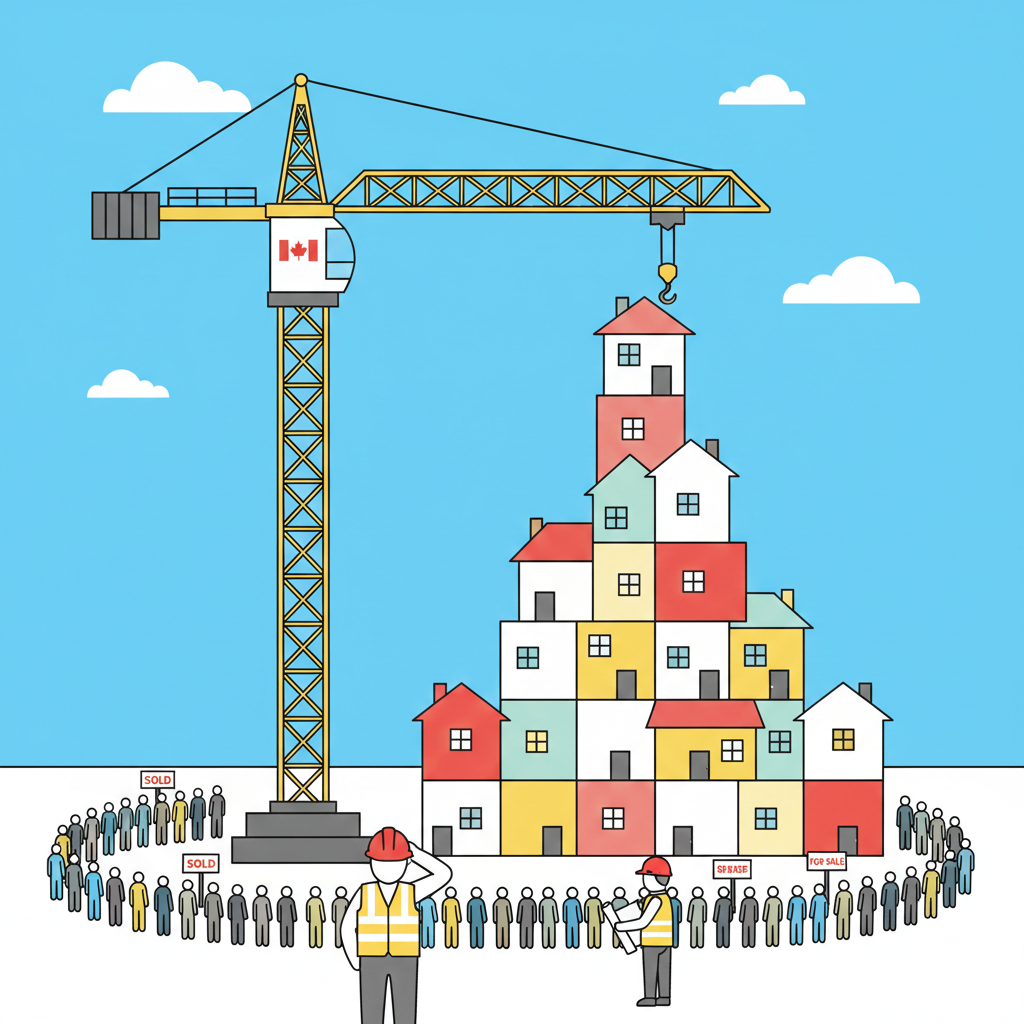
On September 14, 2025, PM Carney launched "Build Canada Homes," a brand new federal housing agency backed by $13 billion. The goal: double the pace of home construction to roughly 500,000 units per year [1]. There's also a GST elimination for first-time homebuyers on homes under $1 million, municipal development charges cut in half for five years, and a $1.5 billion rental protection fund to stop affordable buildings from being flipped into luxury condos [2].
On paper, it reads like someone finally took the housing crisis seriously. In practice, there's a gap between announcing you'll build half a million homes a year and actually finding the humans to swing the hammers.
Where We Are Right Now
Canada currently builds around 240,000-260,000 housing units per year [3]. The Canada Mortgage and Housing Corporation has said, repeatedly, that we need to build 3.5 million additional homes by 2030 to restore affordability [4]. That works out to roughly 580,000 units per year for the next five years, on top of what we're already building.
We're not even close. We've never been close. The best year in recent memory was around 270,000 starts. The government wants to nearly double that number, starting now.
This is like telling someone who runs a 10-minute kilometre that they need to run a 5-minute kilometre by next Tuesday. It's not impossible in theory. In practice, you'd need completely different legs.
The Labour Problem Nobody Wants to Talk About
Canada's construction industry employs about 1.5 million workers [5]. To double housing output, you need roughly double the workforce, or massive productivity improvements, or some combination of both.
Where do an extra 500,000-750,000 construction workers come from?
BuildForce Canada, which tracks labour supply in the construction sector, has been warning about shortages for years. By their estimates, over 300,000 construction workers will retire in the next decade, and the industry will need to recruit roughly 350,000 new workers just to maintain current output levels [6]. That's before you add the ambitious plan to double production.
Training a plumber takes four to five years. An electrician, four years. A crane operator, two years of apprenticeship plus certification. You can't speed-run skilled trades training without compromising safety, and compromising safety in construction means people die.
There are exactly two realistic solutions: dramatically increase trades apprenticeship enrollment starting immediately (with results visible in 3-5 years), or increase immigration of skilled construction workers (with political complications in the current climate).
The government has nodded toward both but committed to neither with the urgency the numbers demand.
The Money Part
Thirteen billion dollars is a lot of money. It's also not as much as it sounds when you're trying to reshape an entire country's housing supply.
For context: a single mid-rise apartment building with 100 units costs roughly $30-50 million to build in a major Canadian city, depending on location and specifications [7]. Thirteen billion dollars, if spent entirely on direct construction, would produce somewhere between 26,000 and 43,000 units. That's helpful. It's not transformative.
The government's theory is that federal money acts as a catalyst, unlocking private investment, accelerating permitting, providing land, and de-risking projects so that private developers build at scale. The $13 billion isn't meant to build 500,000 homes. It's meant to create conditions where the private sector builds 500,000 homes.
That distinction matters because it means the plan works only if developers actually respond to the incentives. If land costs stay high, municipal permitting stays slow, and construction labour stays scarce, the money gets spent without producing the volume that's needed.
The GST Break, in Plain English
First-time homebuyers purchasing a home at or under $1 million pay zero GST. The government estimates this saves buyers up to $50,000 [8].
Fifty thousand dollars is real money. On a $900,000 home, eliminating the 5% GST saves $45,000. That's a down payment boost that puts homeownership within reach for some families who are currently priced out.
The risk economists flag: if the GST break increases demand without a corresponding increase in supply, it pushes prices up. Sellers absorb part of the benefit through higher asking prices, and buyers end up in roughly the same spot. This happened in Australia when similar first-homebuyer grants were introduced. Studies found that roughly 40% of the benefit flowed to sellers through price inflation rather than to buyers through improved affordability [9].
Whether the same thing happens in Canada depends entirely on whether supply keeps pace with the demand boost. Which brings us back to the plumber shortage.
Municipal Development Charges: The Hidden Tax on Your Home
This one's wonky but important, because development charges are one of the biggest hidden costs in new housing.
When a developer builds a new subdivision or condo tower, the municipality charges fees to cover the cost of new infrastructure: roads, sewers, water connections, parks, transit expansion. In Toronto, development charges on a new two-bedroom apartment run around $80,000 [10]. That cost gets baked into the purchase price.
Carney's plan cuts these charges in half for five years [2]. On that Toronto two-bedroom, that's a $40,000 reduction. That saving either lowers the purchase price for buyers or improves the profit margin for developers enough to make marginal projects viable.
Municipalities are nervous about this because development charges fund actual infrastructure. If you cut the charges without replacing the revenue, new neighbourhoods get built without the roads, sewers, and transit to support them. That creates the kind of sprawl that costs more to service in the long run.
The federal government has suggested it will backstop municipal infrastructure costs, but the details are vague enough to keep city finance departments up at night.
The Rental Protection Fund
The $1.5 billion Canada Rental Protection Fund is aimed at a specific problem: private equity firms and investment funds buying up older, affordable rental buildings, renovating them, and re-renting at luxury prices [11].
This has been happening across Canadian cities for a decade. A 1960s apartment building with rents of $1,200 per month gets bought by an investment fund, renovated with new appliances and finishes, and re-rented at $2,200 per month. Legal under most provincial tenancy laws, devastating for the tenants who get displaced.
The protection fund helps non-profit housing organizations buy these buildings first, keeping them as affordable rental stock. It's a defensive measure, not a growth strategy, but it addresses the reality that Canada isn't just failing to build enough affordable housing. We're actively losing the affordable housing we already have.
One-and-a-half billion dollars will protect a few thousand units. The scale of the problem involves hundreds of thousands of at-risk rental units across the country. It's a tourniquet on a wound that needs surgery.
The Ottawa Experiment
As a concrete example of how Build Canada Homes works in practice, the government secured a deal with the City of Ottawa to build up to 3,000 mixed-income and affordable housing units starting in 2026 [12].
Three thousand units in Ottawa sounds modest against a national target of 500,000 per year. But it's a real project with real timelines, real land, and real budgets. If it works, it becomes a template. If it doesn't, it becomes a case study in what goes wrong.
Ottawa's a reasonable test case because it has available federal land (surplus government properties), a growing population, and a municipal government willing to cooperate on permitting. The conditions are about as good as they get. If the model struggles in Ottawa, it will struggle worse in Toronto, Vancouver, and Montreal, where land costs are higher, politics are more complicated, and community opposition to new development is more organized.
The Honest Assessment
Build Canada Homes is the most ambitious federal housing intervention since the post-war period, when the government built entire communities for returning veterans [13]. The money is significant. The policy tools, GST breaks, development charge cuts, rental protection, are well-targeted. The national housing agency creates institutional capacity that didn't exist before.
The plan's success depends on three things the government can't fully control: construction labour supply, municipal cooperation on permitting, and private sector willingness to build at the volumes needed.
If all three come together, Canada could meaningfully improve housing affordability within five to seven years. Not solve it. Improve it. The housing crisis was decades in the making. No single program fixes decades of underbuilding in a single parliamentary term.
If any of the three fail, the money gets spent, some homes get built, and the affordability gap continues to widen. That's not a disaster. It's just insufficient. Which, in Canadian housing policy, would be entirely consistent with historical precedent.
The plan deserves credit for scale and ambition. It deserves scrutiny on execution. And it deserves an honest answer to the question every plumber, electrician, and carpenter in this country is already asking: "You want me to build how many houses?"
References
[1] Prime Minister of Canada. "PM Carney launches Build Canada Homes." September 14, 2025.
[2] Department of Finance Canada. "Budget 2025: Housing Measures." November 2025.
[3] CMHC. "Housing Starts Data." Table 34-10-0143-01. 2025.
[4] CMHC. "Canada's Housing Supply Shortages: Estimating what is needed to restore affordability by 2030." 2023.
[5] Statistics Canada. "Labour Force Survey: Construction Sector." 2025.
[6] BuildForce Canada. "Construction and Maintenance Looking Forward." National Summary. 2025.
[7] Altus Group. "Canadian Cost Guide: Construction." 2025.
[8] Canada Revenue Agency. "GST Elimination for First-Time Homebuyers." 2025.
[9] Productivity Commission of Australia. "First Home Ownership." Research Paper. 2004.
[10] City of Toronto. "Development Charges Rates." 2025.
[11] Prime Minister of Canada. "Canada Rental Protection Fund." 2025.
[12] Prime Minister of Canada. "Ottawa Housing Partnership Announcement." 2025.
[13] CMHC. "The History of Canada's National Housing Strategy." 2018.